Posts

Showing posts with the label Mine countermeasures

Naval Drones - What to Expect in 2016
Image
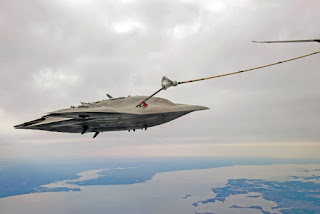
Looking Back at 2015  Our highly unscientific Twitter poll below shows what some readers thought were the most significant events in unmanned naval systems for 2015. Most significant naval drone story of 2015? — Naval Drones (@NavalDrones) December 28, 2015 For details on these stories, see:  X-47B Refueling ,  Russian Kanyon Nuclear UUV ,  UCLASS RFP X-47B takes on fuel And Forward to 2016 What follows are our expectations, hunches, and just wild guesses of the major developments to watch for in naval unmanned systems industry during the coming year. Sanity Prevails  - After spending nearly a billion dollars and more than two decades developing the troubled  Remote Minehunting System , the U.S. Navy will cancel the program.  Lockheed's RMS, which was intended to be one of the Littoral Combat Ship's key mission packages, will be replaced by one or more of the growing number of versatile, less expensive mine-countermeasure UUVs. Also,...
Mine Warfare Unmanned Systems: US Allies are Moving Forward

Image
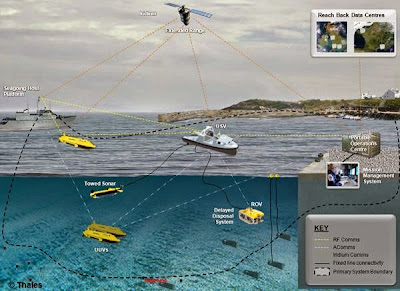
By Dr. Franck Florin, CRUSER Member, VP International Technologies, Thales Defense & Security Inc. During World War II, mines emerged as a major weapon and the British, German and American navies placed more than 215,000 mines in the seas (according to Chris Henry, Depth Charge, 2005). To date, despite constant clearing effort, more than 60% of the mines and unexploded ordnance from that period are still lying on the sea bed near European harbors and along major European navigation channels. In 2012 alone, the French Navy neutralized a total of 2,292 explosive devices in the country territorial waters (50% in the Channel between France and UK, 30% in the Atlantic and 20% in the Mediterranean Sea). With tens of thousands of unexploded ordnances to clear and many international operations abroad to support United Nations peace keeping and NATO crisis management, the European navies need cutting edge technologies to support their Mi...

Minehunting Robots in the Middle East: IMCMEX 2014

Image
This year's United States FIFTH Fleet's International Mine Countermeasures Exercise is well underway in Middle East waters, running until 13 November.  This third iteration of the exercise will be the largest ever, with 6,500 sailors from 44 nations and 38 ships participating.  As with past exercises , unmanned undersea vehicle detachments from several countries will show off their latest hardware in a realistic operating environment.  A total of 19 UUVs will take part in the waters of the Arabian Gulf, the Arabian Sea, and the northern Red Sea.  On the U.S. side, a focus will be placed on overcoming unmanned mine-countermeasures challenges including the transfer of sensor data at sea, reducing unmanned mission duration, and enhancing trust in autonomy.   One of the new unmanned technologies to be demonstrated during the exercise is Northrop Grumman's Mine-Hunting Unit (MHU) .  The MHU unmanned surface vehicle tested  its ability to deploy, tow, and...

Non-traditional Drone Motherships - Cheaper & Better?

Image
Earlier this week, guest blogger Mark Tempest posted some interesting ideas on low cost alternatives to traditional combatants which could be configured to carry unmanned surface vehicles, playing on the idea that payload truly is more important than platform.  These concepts are unorthodox, though as Mark points out, not unprecedented.  In a time of shrinking budgets and smaller fleets, the navy should explore how to optimize various combinations of ships and the unmanned vehicles they will carry, with an eye towards both effectiveness and efficiency.  Mine counter-measures is an important, though often short-changed mission, with various trade-offs between payload and platform. Between the Littoral Combat Ship "seaframe" and mission modules, the U.S. Navy has invested billions of dollars in R&D and acquisition money to develop (though still not fully) the capability to conduct off-board, unmanned mine counter-measures.  LCS will carr...

New UUV Mothership Hits the Fleet: the Coastal Command Boat

Image
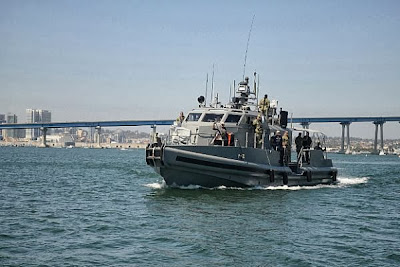
 (Aug. 11, 2013) A 65PB1101 coastal command patrol boat arrives in San Diego. The patrol boat has increased capability over existing Navy Expeditionary  Combat Command craft, including 24-hour mission capability,  ergonomic equipment design, both remote and crew-served weapon  systems and a robust communications suite. (U.S. Navy photo by Lt. Cmdr. Donnell Evans/Released) The U.S. Navy recently introduced the new 65 foot Coastal Command Boat (65PB1101) into the fleet.  Among other maritime security missions, CCB will test new concepts in employing unmanned underwater vehicles.  The one-of-a-kind vessel was developed following a 2008 Congressional earmark for $5 million.  After a transit from its building location in Bremerton, the SAFE Boat-manufactured CCB arrived in  Coronado, California in August where it been assigned to Coastal Riverine Group 1 (CRG-1).  CCB...

Ships vs. UUVs for Mine Clearance - Not Mutually Exclusive

Image
In the July issue of Proceedings  (membership required), Royal Navy Commander John Craig argues for the retention of the U.S. Navy's mine countermeasures fleet primarily because unmanned underwater vehicles cannot replace them.  CDR Craig certainly has the credentials to comment smartly on this subject, having recently commanded Britain's 2nd Mine Countermeasures Squadron (2MCM). Bottom mine seen from SeaFox system camera (RN Photo) The U.S. Navy eventually plans to dispose of its MCM ships (the MHC class mine hunters were previously decommissioned in the 2000s) with the Littoral Combat Ship (LCS) embarked with unmanned MCM systems as a planned replacement.  Regardless of the wisdom of this decision, unmanned underwater vehicles (UUVs) have been embraced by the U.S. and other modern navies, and are being acquired at a rapid pace.  The gradual shift towards unmanned MCM systems is likely a reflection of shrinking defense bu...

IMCMEX 13 - New Drones, New Tactics

Image
Unmanned naval systems played a significant role during last year's International Mine Countermeasures Exercise (IMCMEX). This year, more than 40 nations will operate 18 Unmanned underwater vehicles (UUVs) in the Persian Gulf during what has become arguably the world's premiere mine counter-measures demonstration.  IMCMEX 13 has also been expanded to include maritime infrastructure protection (MIP) and maritime security operations (MSO) mission sets.  The exercise is breaking new ground both in platforms and tactics. As with MCMEX 12,  USS Ponce will be a major focus area, demonstrating trials of various sorts of mother ship configurations to expedite the deployment of UUVs into suspected mine fields.  This experimentation offers a hedge to mitigate risk against the still yet to be operational Littoral Combat Ship (LCS) mine warfare mission package.  Conceivably, a well-deck equipped amphibious ship...

Tactical Employment of Drone Motherships

Image
As  discussed in an earlier post , dynamics between unmanned naval systems and the platforms that carry them are changing rapidly to accomodate new technologies and tactics.  Arguably, various types of drone motherships have the potential to transform mine countermeasures more than any other warfare area and the evolution in mine-countermeasures tactics towards the mothership-unmanned underwater vehicle (UUV) partnership is already underway.  One of the first major demonstrations of this concept occurred last summer during 5th Fleet's International Mine Countermeasures Exercise ( IMCMEX ) when a number of UUVs were tested from large amphibious motherships including USS Ponce ((AFSB(I)-15). Essentially, the Navy is moving from dedicated MCM ships such as the Avenger class minesweeper, to a trio of platforms: a Generation I mothership, carrying Generation II platforms (a RHIB specially modified to carry UUVs; seen b...

LCS Program Office for Unmanned Systems in the News

San Diego's ABC affiliate recently did an informative piece featuring Captain Duane Ashton, from Naval Sea Systems Command Program Executive Office for Littoral and Mine Warfare Unmanned Maritime Systems Program Office (PMS 406).  Capt Ashton discusses some of the stand-off unmanned mine countermeasures capabilities under development for the Littoral Combat Ship (LCS) including the Unmanned Influence Sweep System (UISS)  and the Knifefish UUV. 

Naval Drones 2012 Year in Review

Image
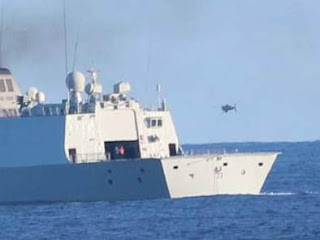
What were the top stories in unmanned naval technology during 2012?  What follows is a completely unscientific count-down of the major events related to naval drones over the past year: 10. The Japanese Maritime Self Defense Force captures a flock of Schiebel S-100 UAVs operating from PLAN frigate on film. Camcopter variant operating off Chinese Frigate. 9. SAIC was awarded a contract for the planned DARPA ASW drone , Anti-Submarine Warfare (ASW) Continuous Trail Unmanned Vessel (ACTUV), which will autonomously hunt and track diesel subs. SAIC rendering of ACTUV's unique tri-maran hull form. 8. DARPA *almost* conducts air-to-air refueling of UAVs .  Trials actually transferring fuel were postponed due to BAMS-D crash (See #3). RQ-4 Global Hawks in formation for DARPA drogue and probe refueling demonstration. 7. Kongsberg Maritime's Hydroid subsidiary REMUS mine-hunting AUVs proliferate gl...

What You Can’t Find…

Image
A frequently cited fact in my days training to be a naval officer was that the most common weapon for damaging a warship since World War II was the naval mine . The recently concluded International Mine Countermeasures Exercise 2012 (IMCMEX 12), held in 3 distinct OPAREAs throughout the U.S. Fifth Fleet Area of Responsibility (AOR), demonstrated both the difficulty of mine countermeasures (MCM) operations (detecting and clearing mines) and the potential of new technology to mitigate those dangers. PBS’ News Hour quotes a retired naval officer and observer of the exercise, Capt. Robert O’Donnell, stating of the 29 simulated mines in the exercise, “I don’t think a great many were found…It was probably around half or less.” The response from the Navy is a little confusing: The Navy declined to provide data on how many practice mines were located during the two-week naval drill but did not dispute that less than half were found. However, a spokesman insisted that the figures do ...

Reversing Asymmetry with Unmanned Naval Systems

Image
A constant tit for tat churn in weapons technology has pervaded the history of warfare in many forms: English long bows vs. chain mail armor; carrier-based aircraft vs. dreadnaughts; home-made fertilizer explosives vs. MRAPs, just to name a few.   Used creatively in the hands of a determined foe, both archaic weapons and more high technology systems can overwhelm even the most modern naval defenses.   Relatively affordable sea m ines, anti-ship cruise missiles, and diesel submarines have proliferated at a startling rate to emerging countries and non-state actors.  The quantities of these weapons globally present a real threat to sophisticated navies, who struggle to keep up procurement rates of ever-more expensive modern combatants and weapons systems in a time of defense austerity.  Unmanned naval systems represent an opportunity to reverse this asymmetry once again. The cusp of this reversal is evident in recent de...

Still More IMCMEX 12 Unmanned Systems...

Image
As FIFTH Fleet's major mine countermeasures exercise continues, we learn "Task Group North" flagship USS Ponce (AFSB(I)-15) operating in the Persian Gulf isn't the only MCM mother ship. More than 1,000 miles to the South, USS Gunston Hall (LSD 44) is hosting Royal Navy MCM ops in the Gulf of Aden.  Another interesting observation is that the Amercians, British, Dutch, and Kiwis are all deploying variants of the Hydroid REMUS UUV . Whether intentional or not, this systems compatiblity will ensure coalition operations and logistics support during any future mine warfare contingency occur more smoothly. GULF OF ADEN (September 19, 2012) -- British Royal Navy Diver Petty Officer Grahame Sheppard, left, and British Royal Navy Diver Chief Petty Officer Alan Knowles tests GPS for a REMUS 100 Sidescan SONAR, an autonomous underwater vehicle (AUV), on the boat deck aboard amphibious dock-landing ship USS Gunst...

Drones v. Mines

Image
Earlier this week, navies from over 30 nations began the International Mine Countermeasures Exercise (IMCMEX) 12.  As discussed here previously , unmanned naval systems increasingly play a role in reducing the risk to sailors engaged in mine clearance operations and IMCMEX provides a realistic testing opportunity for this equipment.  Before the operational part of the exercise got underway, participants had an opportunity to scope out some of the latest mine hunting technology in Manama, Bahrain.  Some multimedia highlights: FIFTH Fleet IMCMEX Video featuring snippets of SeaFox, Kingfish, and a VideoRay ROV.  U.S. Navy video by Mass Communications Specialist 2nd Class Blake Midnight/Released)  Japanese Maritime Self-Defense Force Officers listen to a demonstration of the Bluefin-9 Shallow Water AUV in Manama, Bahrain. (U.S. Navy photo by Chief Mass Communications Specialist Joshua L. Treadwell/Released) ...

Mine Warfare Gets a Boost From Drones

Image
Royal Navy Sailors display a SeaFox UUV. It is common knowledge that mines have damaged more U.S. Navy ships than any other weapon since World War II.  During the same period, however, the Navy's focus on Mine Warfare  has waxed and waned.  The looming possibility of Iranian mines closing the Strait of Hormuz has once again put mine-countermeasures (MCM) on the upswing.  The Navy's future MCM force will be based on the Littoral Combat Ship and her MCM mission package which has yet to be deployed operationally.  In the meanwhile, the venerable fleet of Avenger Class minesweepers will provide the bulk of this important capability.  Four of the fiberglass-sheathed, wooden-hulled MCMs arrived in the Gulf in June to bolster the four ships already forward deployed to Bahrain.  Although t he average age of these ships is over 23 years, their hull, mechanical, electrical, and combat systems suite...