Posts

Showing posts with the label LCS

Unmanned Systems and Distributed Operations: Out of One, Many

Let’s face facts: it appears the U.S. Navy is incapable of building surface combatants, even small ones, for less than about a billion dollars apiece.  Consequently, it is likely the fleet will continue to shrink for the foreseeable future.  Yet it appears that the global demand for surface ship presence remains high for both peacetime operations and as an on-call force for contingency response.  So how can the Navy continue to meet worldwide operational commitments given fewer ships?  The key to maximizing the effectiveness of a declining surface force lies in combining suitable motherships with the latest unmanned warfighting technology.   Unmanned naval systems are rapidly proliferating internationally because they are increasingly capable and cheaper than manned alternatives for certain missions.  To date, sea-based unmanned systems have primarily conducted intelligence, surveillance, reconnaissance and mine countermeasures operations.  But w...

Non-traditional Drone Motherships - Cheaper & Better?

Image
Earlier this week, guest blogger Mark Tempest posted some interesting ideas on low cost alternatives to traditional combatants which could be configured to carry unmanned surface vehicles, playing on the idea that payload truly is more important than platform.  These concepts are unorthodox, though as Mark points out, not unprecedented.  In a time of shrinking budgets and smaller fleets, the navy should explore how to optimize various combinations of ships and the unmanned vehicles they will carry, with an eye towards both effectiveness and efficiency.  Mine counter-measures is an important, though often short-changed mission, with various trade-offs between payload and platform. Between the Littoral Combat Ship "seaframe" and mission modules, the U.S. Navy has invested billions of dollars in R&D and acquisition money to develop (though still not fully) the capability to conduct off-board, unmanned mine counter-measures.  LCS will carr...

IMCMEX 13 - New Drones, New Tactics

Image
Unmanned naval systems played a significant role during last year's International Mine Countermeasures Exercise (IMCMEX). This year, more than 40 nations will operate 18 Unmanned underwater vehicles (UUVs) in the Persian Gulf during what has become arguably the world's premiere mine counter-measures demonstration.  IMCMEX 13 has also been expanded to include maritime infrastructure protection (MIP) and maritime security operations (MSO) mission sets.  The exercise is breaking new ground both in platforms and tactics. As with MCMEX 12,  USS Ponce will be a major focus area, demonstrating trials of various sorts of mother ship configurations to expedite the deployment of UUVs into suspected mine fields.  This experimentation offers a hedge to mitigate risk against the still yet to be operational Littoral Combat Ship (LCS) mine warfare mission package.  Conceivably, a well-deck equipped amphibious ship...

LCS Program Office for Unmanned Systems in the News

San Diego's ABC affiliate recently did an informative piece featuring Captain Duane Ashton, from Naval Sea Systems Command Program Executive Office for Littoral and Mine Warfare Unmanned Maritime Systems Program Office (PMS 406).  Capt Ashton discusses some of the stand-off unmanned mine countermeasures capabilities under development for the Littoral Combat Ship (LCS) including the Unmanned Influence Sweep System (UISS)  and the Knifefish UUV. 

Navy Looks to Small Business to Solve RMS Problems‏

Image
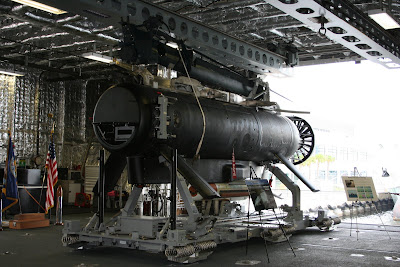
Lockheed Martin's troubled  AN/WLD-1 Remote Minehunting System is the key component of the U.S. Navy's Littoral Combat Ship Mine Counter-measures Mission Package (MCM MP) and   has been under development for nearly two decades.   The heart of the system is a diesel-powered, semi-submersible Remote Multi-Mission Vehicle (RMMV)  designed to tow a variable depth mine-hunting sonar.  AN/WLD-1 aboard USS Freedom (LCS-2) Testing on RMS prototypes began in 1994, but the system has yet to mature to full operational status.  In an effort to work some of the kinks out of RMS, the Navy's Program Executive Officer for Littoral Combat Ships (PEO LCS)  has sought the assistance of industry via the most recent Small Business Innovation Research ( SBIR ) program solicitation.     A solicitation released by the Remote Minehunting System Program Office (PMS 403) entitled " Anticorrosion Solution for Re...

U.S. CNO Makes Unmanned Systems a Priority

Image
PALMDALE, Calif. (Aug. 8, 2012) Chief of Naval Operations (CNO) Adm. Jonathan Greenert observes a fly-by demonstration of a Predator C Avenger unmanned aerial vehicle. (U.S. Navy photo by Mass Communication Specialist 1st Class Peter D. Lawlor/Released) In a nod to maritime tradition, the new Chief of Naval Operations set forth a " Navigation Plan " with budgetary priorities and a route to achieve the vision he set in the " Sailing Directions " for 2013-2017.  Admiral Greenert's prioritization of unmanned systems for the U.S. fleet in these documents is anything but archaic.  Seven of the CNO's 34 budget focus areas directly address unmanned systems, including: "Increase near-term mine warfare capability with Quickstrike mines; the Seafox Mine Neutralization System ; upgraded MCM-1 class ship sonar, hull, and engineering upgrades; and Unmanned Underwater Vehicles (UUV) for shallow and bottom mine detection. Improve near-term cap...