Posts

Showing posts with the label Fire Scout

What's the Buzz? Ship-based Unmanned Aviation and its Influence on Littoral Navies During Combat Operations.
Image
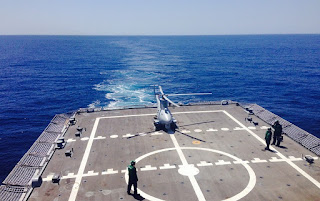
By Ben Ho Wan Beng Introduction   “Unmanned aviation” has been a buzzword in the airpower community during recent years with the growing prevalence of unmanned systems to complement and in some cases replace peopled ones in key roles like intelligence, surveillance and reconnaissance (ISR). Insofar as unmanned aerial vehicles (UAVs) are increasingly used for strike, their dominant mission is still ISR because of the fledging state of pilotless technology. This is especially the case for sea-based drones, which are generally less capable than their brethren ashore. That said, several littoral navies have jumped on the shipborne UAV bandwagon owing to its relative utility and cost-effectiveness. [1]  And with access to such platforms, how would these entities be effected during combat? For littoral nations without an aerial maritime ISR capability in the form of maritime patrol aircraft (or only having a limited MPA capability), the sea-based drone can make up for t...

Where is the U.S. Navy Going To Put Them All? (Part 2)

Image
Part 2: UUVs, Fire Scouts and buoys and why the Navy needs lot’s of them. Guest post  by Jan Musil. Sketch by Jan Musil. Hand drawn on  quarter-inch graph paper. Each  square equals twenty by twenty feet. This article, the second of the series, lays out a suggested doctrine of use for the UUVs and Fire Scouts that have already been developed. It is an incremental strategy, primarily calling for using what the Navy already has in hand, adding use of buoys in quantity combined with appropriate doctrinal changes and vigorously applying the result to the ASW mission. In getting this program underway the U.S. Navy can utilize existing sensors, whether for prosecuting ASW, developing sonar projections of the water below, including occasional deep diving missions and whatever else we find a need for the UUV to do. In practice though, generating useful results is far easier to accomplish if the UUV is routinely, though not exclusively, used with a tether so the data...

Distributed Endurance: Logistics and Distributed Lethality

Image
The following is a submission by guest author Chris O’Connor for CIMSEC’s Distributed Lethality week, reprinted with permission of the Center for International Maritime Security . Distributed lethality is a concept that harkens back to the glory days of the US Navy in the age of sail: small groups of ships with operational autonomy fighting the enemy with their organic firepower and capabilities. Operational autonomy was the default state for ships  until Marconi’s radio set--the lack of instantaneous communication meant that commanders had to make decisions by themselves. Concerning distributed lethality, the lack of communications is imposed upon our ships by enemy communications denial in an A2/AD environment. The parallel does not work in the logistics domain as well- warships then had to fend for themselves logistically, while today, we will have to force a new mode of supply on our ships in order for them to operate independently. There are some lessons we can learn fro...

Death from Above

Image
It’s not often that a book review coincides with current events. Books, particularly nonfiction, are usually written and published months, if not years after an event has occurred. That’s because good nonfiction is written in retrospect: writers have spent some time absorbing their subject, researching and analyzing the facts; authors are hesitant to be rash in judgment or thought. However, there are exceptions. Some pieces of nonfiction, particularly journalists’ works, are appropriate now — not later. Andrew Cockburn’s new book,  Kill Chain: The Rise of the High-Tech Assassins , is one of them.  Cockburn’s book is timely.  In just the past few weeks there has been a flood of  reporting from media outlets  stating  that a drone strike killed an American and an Italian hostage when targeting a group of Al-Qaeda members operating near the Afghanistan-Pakistan border. Suddenly, questions about drone strikes, the debate about targeted killing, and th...

Exploring Unmanned System Autonomy in the DoD

Editor's note: Reprinted with permission from the Naval Postgraduate School's  CRUSER News .  by LCDR Nathaniel Spurr, NPS Systems Engineering Student, ncspurr(at)nps.edu  The objective of the Center for Technology and National Security Policy (CTNSP) symposium held on February 24th 2015 at the National Defense University was to foster an open, unclassified discussion regarding the potential that unmanned system autonomy has within the Department of Defense (DoD) in the 2025 timeframe. This topic was of critical importance to the development of SEA-21A’s integrated project that seeks to provide a recommended maritime system of systems (SoS) to support over-the horizon targeting (OTHT) in a contested littoral environment during the same period. The symposium began with a keynote address by General James E. Cartwright, USMC (Ret), former Vice Chairman of the Joint Chiefs of Staff where he emphasized the partnered role of autonomy and human interaction, followed by prese...

2014: The Year in Naval Drones

Image
It's time for our annual wrap-up of the stories on unmanned naval systems that most resonated on this site, social media feeds, and the public writ large.  Here are the top naval drone stories of the year: The introduction of UAVs for maritime missions by non-state actors, specifically migrant rescue and anti-piracy , became reality. The Royal Navy established a UAV Squadron  to intitutionalize its ScanEagle operations . Despite continued operational testing with the X-47B prototype, politics and indecision created further delays with the U.S. Navy's  UCLASS RFP (still not released by the way). Unmanned systems were key in the Malaysian Airlines Flight #370 Search . The  MQ-8C Fire Scout made significant strides towards its first operational deployment. The U.S. Navy's  Swarming USV program , really a plug and play unmanned craft system, garnered significant interest. Interestingly, the story that seemed to p...

Chief of Naval Operations Continues Focus on Unmanned Systems

Image
2 May 2014 - Chief of Naval Operations (CNO) Adm. Jonathan Greenert tours Pennsylvania State University's Applied Research Laboratory facilities to see firsthand their innovative anti-torpedo torpedoes and unmanned undersea vehicles. (U.S. Navy photo by Chief Mass Communication Specialist Peter D. Lawlor/Released) Since he assumed office in 2011, the development of unmanned systems payloads has been a priority during the tenure of U.S. Chief of Naval Operations Admiral Jonathon Greenert.  His recent  Position Report  provides updates to several programs discussed in his original  Navigation Plan. Highlights related to unmanned systems include: Undersea Warfare "In the fall of 2014, our large displacement unmanned undersea vehicle ( LDUUV ) program reached its first acquisition gate, Milestone A, which initiated technology development." Unmanned Air Systems "We continued testing the  X-47B  Unmanned Carrier Aircraft System Demonstrator, and for t...

Private Security Drones for Anti-piracy Ops

Image
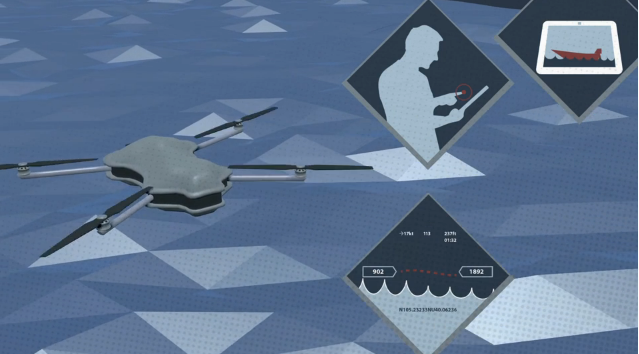
Depiction of ATAC Anti-piracy UAV. We've talked about privately-funded drones for maritime eco-activism  and   humanitarian operations , so it's not surprising to see another naval mission where unmanned air vehicles have bled into the private sector.  Now, at least one private security company has offered UAV services as an anti-piracy solution. Commercial shipping companies embraced private security as a means for protecting their ships after piracy in the Indian Ocean expanded significantly in the late 2000's, putting crews at risk and costing shippers billions in dollars in increased insurance premiums. Incidents of Somali piracy have been virtually non-existent since 2012, primarily due to the hardening of commercial shipping targets by embarked security teams. Other counter-measures, such as fire hoses, razor wire, and hardened crew citadels were too easily defeated by pirates, but to date, no ship with an armed security team has been successfully hij...