Posts

Showing posts with the label X-47B

Naval Drones - What to Expect in 2016
Image
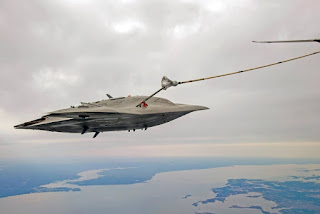
Looking Back at 2015  Our highly unscientific Twitter poll below shows what some readers thought were the most significant events in unmanned naval systems for 2015. Most significant naval drone story of 2015? — Naval Drones (@NavalDrones) December 28, 2015 For details on these stories, see:  X-47B Refueling ,  Russian Kanyon Nuclear UUV ,  UCLASS RFP X-47B takes on fuel And Forward to 2016 What follows are our expectations, hunches, and just wild guesses of the major developments to watch for in naval unmanned systems industry during the coming year. Sanity Prevails  - After spending nearly a billion dollars and more than two decades developing the troubled  Remote Minehunting System , the U.S. Navy will cancel the program.  Lockheed's RMS, which was intended to be one of the Littoral Combat Ship's key mission packages, will be replaced by one or more of the growing number of versatile, less expensive mine-countermeasure UUVs. Also,...

Death from Above

Image
It’s not often that a book review coincides with current events. Books, particularly nonfiction, are usually written and published months, if not years after an event has occurred. That’s because good nonfiction is written in retrospect: writers have spent some time absorbing their subject, researching and analyzing the facts; authors are hesitant to be rash in judgment or thought. However, there are exceptions. Some pieces of nonfiction, particularly journalists’ works, are appropriate now — not later. Andrew Cockburn’s new book,  Kill Chain: The Rise of the High-Tech Assassins , is one of them.  Cockburn’s book is timely.  In just the past few weeks there has been a flood of  reporting from media outlets  stating  that a drone strike killed an American and an Italian hostage when targeting a group of Al-Qaeda members operating near the Afghanistan-Pakistan border. Suddenly, questions about drone strikes, the debate about targeted killing, and th...

Chief of Naval Operations Continues Focus on Unmanned Systems

Image
2 May 2014 - Chief of Naval Operations (CNO) Adm. Jonathan Greenert tours Pennsylvania State University's Applied Research Laboratory facilities to see firsthand their innovative anti-torpedo torpedoes and unmanned undersea vehicles. (U.S. Navy photo by Chief Mass Communication Specialist Peter D. Lawlor/Released) Since he assumed office in 2011, the development of unmanned systems payloads has been a priority during the tenure of U.S. Chief of Naval Operations Admiral Jonathon Greenert.  His recent  Position Report  provides updates to several programs discussed in his original  Navigation Plan. Highlights related to unmanned systems include: Undersea Warfare "In the fall of 2014, our large displacement unmanned undersea vehicle ( LDUUV ) program reached its first acquisition gate, Milestone A, which initiated technology development." Unmanned Air Systems "We continued testing the  X-47B  Unmanned Carrier Aircraft System Demonstrator, and for t...

A New Kind of Drone War: UCAV vs. UCLASS

The Australian government recently approved the acquisition of a fleet of US Navy  Triton   surveillance drones  to patrol our oceans. Australia has mostly used Israeli drones to date, such as the  Heron s in Afghanistan. So as we dip our toes into the American UAV market, it’s worth taking note of a recent development that might be threatening US primacy in this area. While the  Predator  and  Reaper  laid the groundwork for the use of armed drones in warfare, a question remains about the survivability of the technology against modern air defences. Developing a stealthy long-range drone with a decent weapons payload that could go beyond missions in Yemen and Pakistan appeared to be the next order of business for the US, especially in the future Asia-Pacific theatre. Projects like the demonstrator  X-47B  unmanned combat air vehicle (UCAV) have shown promise in achieving those missions. But for now the US Navy has decided to go for a...

2013: The Year in Sea Drones

Image
What was the most significant development in unmanned naval systems for 2013?  Blog readers weighed in on this question and more during our survey. Winning by a landslide, with 71% of the responses, was the successful carrier catapult shots and "traps" (arrested landings) of Northrop Grumman's X-47B. ALANTIC OCEAN (Nov. 9, 2013) The experimental X-47B Unmanned Combat Air System Demonstrator (UCAS-D) conducts an arrested landing aboard the aircraft carrier USS Theodore Roosevelt (CVN 71). Theodore Roosevelt is the third carrier to test the tailless, unmanned autonomous air craft's ability to integrate with carrier environment. (US Navy photo By Mass Communication Specialist Seaman Anthony N. Hilkowski/Released) In a distant second, with 19% of the vote, was the proliferation of sea-going rotary wing UAVs. The number of helicopter drones, like this Spanish Skeldar, grew throughout the world's fleets in 2013. Related to #1, the U.S. Navy's ev...

Unmanned Naval Helicopters Take-off in 2013

Image
Manned (SH-60B) and unmanned (MQ-8B) helicopters working together on USS Halyburton (FFG 40) - Navy photo The carrier take-off and arrested landings of the U.S. Navy's X-47B demonstrator have garnered significant press attention this year.  Less noticed however, is the rapid development of rotary-wing unmanned aerial vehicles in the world's navies.  Recent operational successes of Northrop Grumman's MQ-8B Fire Scout aboard U.S. Navy frigates have led to many countries recognizing the value of vertical take-off and landing UAVs for maritime use.  International navies see the versatility and cost savings that unmanned rotary wing platforms can bring to maritime operations.  Like their manned counter-parts, these UAVs conduct a variety of missions including intelligence, surveillance, and reconnaissance; cargo resupply/vertical replenishment; and in some future conflict will perform armed interdic...

Video Game AI and the Future UCAV Top Gun

Image
By Matt Hipple A  Roomba   is useful because it can sweep up regular messes without constant intervention, not because it can exit and enter its docking station independently. Although the Navy’s new X-47B Unmanned Combat Air Vehicle (UCAV) has, by landing on a carrier ,  executed an astounding feat even for humans, this ability only means our weapons have matured past their typical one-way trips. The real challenge will be getting a UCAV to defend units while sweeping up the enemy without remote guidance   (i.e. autonomously) . The answer is as close as the games running on your Xbox console. Player One: Insert Coin Considering the challenge of how an air-to-air UCAV might be programmed, recall that multiple generations of America’s youth have already fought untold legions of advanced UCAV’s . Developers have created artificial “intelligences” designed to combat a human opponent in operational and tactical scenarios with imperfect information; video games hav...

X-47B Sea Trials - A BFD

Image
My twitter feed was abuzz today with statements lauding this morning's launch of the U.S. X-47B unmanned carrier air system from USS George H. W. Bush (CVN 77): "...another great first for naval aviation...History has just been made...Momento histórico...the Next Era of Naval Aviation...Launch Catapults Naval Aviation into the Future...New era in warfare...MOMENTOUS...Watershed...a pivotal milestone in naval aviation...game-changing technology," etc. There is a bit of truth in all of these.  Though perhaps the event is best summarized in the words of Vice President Biden.

Unmanned ISR and Future Air Wing Composition

Image
According to Defense News , the U.S. Navy's inventory of manned intelligence, surveillance, and reconaissance (ISR) platforms - land-based P-3 Orion and EP-3 Aries - will be cut by more than a quarter over the next few years.  The current consolidations are not the first time in recent history the Navy has trimmed ISR capability.  As late as  the 1990s, a typical carrier air wing deployed with a number of organic platforms capable of collecting intelligence, including tactical aircraft such as the F-14 with the Tactical Airborne Reconnaissance Pod System (TARPS) and ES-3A Shadows for electronic signals intercept (ELINT).  These aircraft were supplemented by a robust ground-based P-3 fleet along with numerous FLIR and radar capable helicopters on smaller cruisers and destroyers. Today's remaining manned aircraft, such as the venerable, but still effective, P-3s are today often found flying over-la...

Investing in Unmanned Naval Systems

The market for unmanned naval systems is growing by leaps and bounds.  Between air, surface, and subsurface platforms, a variety of companies big and small are competing for contracts to meet the demand of navies across the globe.  To provide some perspective on this market, NavalDrones has analyzed the performance of a theoretical portfolio of 12 publically-traded stocks  during 2012.  These stocks range from well-entrenched defense giants like Lockheed Martin( LMT ) and Boeing( BA ) to mid-sized companies producing sensors and other components for naval drones  including Griffon ( GFF ) and Cubic ( CUB ).  With $1,000 invested equally in each of the stocks at the beginning of 2012, the portfolio's initial investment of $12,000 would have been valued at $13,196.12 at the market's close on December 31, for a total return (inclusive of dividends) of 9.97%.  In comparison wit...

Naval Drones 2012 Year in Review

Image
What were the top stories in unmanned naval technology during 2012?  What follows is a completely unscientific count-down of the major events related to naval drones over the past year: 10. The Japanese Maritime Self Defense Force captures a flock of Schiebel S-100 UAVs operating from PLAN frigate on film. Camcopter variant operating off Chinese Frigate. 9. SAIC was awarded a contract for the planned DARPA ASW drone , Anti-Submarine Warfare (ASW) Continuous Trail Unmanned Vessel (ACTUV), which will autonomously hunt and track diesel subs. SAIC rendering of ACTUV's unique tri-maran hull form. 8. DARPA *almost* conducts air-to-air refueling of UAVs .  Trials actually transferring fuel were postponed due to BAMS-D crash (See #3). RQ-4 Global Hawks in formation for DARPA drogue and probe refueling demonstration. 7. Kongsberg Maritime's Hydroid subsidiary REMUS mine-hunting AUVs proliferate gl...

Sea-Based Drones & the Future of Counterterrorism

Image
In a recent Washington Post editorial , Kimberly and Frederick Kagan take a solid position on why the U.S. should maintain a troop presence to support counterterrorism operations in Afghanistan post-2014. The bulk of their argument for continued U.S. ground deployments revolves around the tyranny of distance’s impact on future counterterrorism (CT) operations against the al Qaeda (AQ) network: North Waziristan is more than 600 miles from the nearest coastline; the other sanctuaries are farther. The U.S. Air Force reports that armed Predator drones have a range of about 1,150 miles - not enough to get to Waziristan and back again from the coast, much less to orbit and observe a target. Special mission units would have to parachute from transport aircraft because no helicopter in the U.S. inventory can fly that far. But they could not return because aircraft cannot land in the mountains of Eastern Afghanistan or in Pakistan. Manned aircraft can drop precision weapons on targets in...