Posts

Showing posts with the label ScanEagle

After Distributed Lethality - Unmanned Netted Lethality
Image
By Javier Gonzalez Distributed lethality was introduced to the fleet in January 2015 as a response to the development of very capable anti-access area-denial (A2/AD) weapons and sensors specifically designed to deny access to a contested area. The main goal is to complicate the environment for our adversaries by increasing surface-force lethality—particularly with our offensive weapons—and transform the concept of operations for surface action groups (SAGs), thus shifting the enemy’s focus from capital ships to every ship in the fleet. Rear Admiral Fanta said it best: “If it floats, it fights.” The real challenge is to accomplish this with no major funding increase, no increase in the number of ships, and no major technology introductions. The Navy has successfully implemented this concept by repurposing existing technology and actively pursuing long-range anti-ship weapons for every platform. An illustrative example of the results of these efforts is the current initiative to once...
What's the Buzz? Ship-based Unmanned Aviation and its Influence on Littoral Navies During Combat Operations.

Image
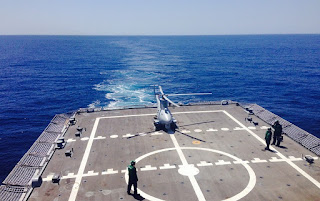
By Ben Ho Wan Beng Introduction   “Unmanned aviation” has been a buzzword in the airpower community during recent years with the growing prevalence of unmanned systems to complement and in some cases replace peopled ones in key roles like intelligence, surveillance and reconnaissance (ISR). Insofar as unmanned aerial vehicles (UAVs) are increasingly used for strike, their dominant mission is still ISR because of the fledging state of pilotless technology. This is especially the case for sea-based drones, which are generally less capable than their brethren ashore. That said, several littoral navies have jumped on the shipborne UAV bandwagon owing to its relative utility and cost-effectiveness. [1]  And with access to such platforms, how would these entities be effected during combat? For littoral nations without an aerial maritime ISR capability in the form of maritime patrol aircraft (or only having a limited MPA capability), the sea-based drone can make up for t...

UAVs Compete for Dominance in the Arctic

Image
The Arctic Circle is a complex environment of harsh climate, shifting ice flows, and remote, barren wastelands. Much ado has been made of late of the region's potential for alternative shipping routes, resource extraction, and of course, the expanded military presence usually associated with those activities. The vast distances and unforgiving temperatures of Arctic air and waters make unmanned aerial vehicles ideal for military reconnaissance there. Practically all of the countries which border Arctic seas have some sort of UAV programs underway. One of the primary goals of Canada's troubled  Joint Uninhabited Surveillance and Target Acquisition System (JUSTAS) project was to conduct Northern Patrols over the country's Arctic territory. In addition to surveilling the area, the yet to be determined type of JUSTAS UAVs will be required to drop search and rescue kits to distressed mariners.  The program's delays have been largely due to competing requirements bet...

Private Security Drones for Anti-piracy Ops

Image
Depiction of ATAC Anti-piracy UAV. We've talked about privately-funded drones for maritime eco-activism  and   humanitarian operations , so it's not surprising to see another naval mission where unmanned air vehicles have bled into the private sector.  Now, at least one private security company has offered UAV services as an anti-piracy solution. Commercial shipping companies embraced private security as a means for protecting their ships after piracy in the Indian Ocean expanded significantly in the late 2000's, putting crews at risk and costing shippers billions in dollars in increased insurance premiums. Incidents of Somali piracy have been virtually non-existent since 2012, primarily due to the hardening of commercial shipping targets by embarked security teams. Other counter-measures, such as fire hoses, razor wire, and hardened crew citadels were too easily defeated by pirates, but to date, no ship with an armed security team has been successfully hij...

The Ever-Expanding Mission Set of Naval Drones

Image
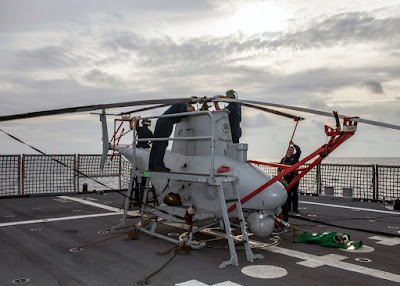
Migrants rescued by the frigate Maestrale. Image courtesy Marina Militare. Hardly a single naval mission area remains that has been untouched by unmanned systems of the air, surface, or undersea variety.  Most recently, Italy's navy announced that with the help of surveillance from an unmanned air system, 1,049 African migrants en route to Sicily had been rescued.   The ongoing rescue missions are part of Operation "Mare Nostrum"(Our Sea), which has been underway since last fall when over 400 migrants from Eritirea and Syria perished near Italy's coasts. Presumably, the drone the Italians referenced was the ScanEagle, which was initially evaluated for ship-board use in October 2010. Two systems each consisting of 5 fixed-wing aircraft were purchased to be employed by the Maestrale Class Frigate beginning this year.  The Italians also recently acquired the  S-100 Camcopter , intended for counter-piracy duties in the Indian Ocean. 

Unmanned Systems and Distributed Operations: Out of One, Many

Let’s face facts: it appears the U.S. Navy is incapable of building surface combatants, even small ones, for less than about a billion dollars apiece.  Consequently, it is likely the fleet will continue to shrink for the foreseeable future.  Yet it appears that the global demand for surface ship presence remains high for both peacetime operations and as an on-call force for contingency response.  So how can the Navy continue to meet worldwide operational commitments given fewer ships?  The key to maximizing the effectiveness of a declining surface force lies in combining suitable motherships with the latest unmanned warfighting technology.   Unmanned naval systems are rapidly proliferating internationally because they are increasingly capable and cheaper than manned alternatives for certain missions.  To date, sea-based unmanned systems have primarily conducted intelligence, surveillance, reconnaissance and mine countermeasures operations.  But w...

2013: The Year in Sea Drones

Image
What was the most significant development in unmanned naval systems for 2013?  Blog readers weighed in on this question and more during our survey. Winning by a landslide, with 71% of the responses, was the successful carrier catapult shots and "traps" (arrested landings) of Northrop Grumman's X-47B. ALANTIC OCEAN (Nov. 9, 2013) The experimental X-47B Unmanned Combat Air System Demonstrator (UCAS-D) conducts an arrested landing aboard the aircraft carrier USS Theodore Roosevelt (CVN 71). Theodore Roosevelt is the third carrier to test the tailless, unmanned autonomous air craft's ability to integrate with carrier environment. (US Navy photo By Mass Communication Specialist Seaman Anthony N. Hilkowski/Released) In a distant second, with 19% of the vote, was the proliferation of sea-going rotary wing UAVs. The number of helicopter drones, like this Spanish Skeldar, grew throughout the world's fleets in 2013. Related to #1, the U.S. Navy's ev...

Assessing UAV Survivability

Image
An oft-cited draw-back of unmanned air systems is their vulnerability to a variety of threats including both physical, such as anti-aircraft fire, and electronic, including jamming.  Researchers and industry are beginning to more seriously examine these threats as the number of drones operating proliferates. How do UAVs stack up against these various threats, especially in the maritime environment? On the physical side, depending on what altitude they are operating, maritime UAVs face similar threats to helicopters and patrol aircraft.  Small tactical UAS flying surveillance missions at relatively low altitudes over-land or water are vulnerable to the simplest anti-aircraft threat, small arms fire .  In 2011, a Fire Scout UAV operating from USS Halyburton (FFG 40) over Libya was shot down by some sort of ground fire.  While flying over-water, drones might face close-in-weapons systems ranging from 20-30 mm to lar...

Unmanned ISR and Future Air Wing Composition

Image
According to Defense News , the U.S. Navy's inventory of manned intelligence, surveillance, and reconaissance (ISR) platforms - land-based P-3 Orion and EP-3 Aries - will be cut by more than a quarter over the next few years.  The current consolidations are not the first time in recent history the Navy has trimmed ISR capability.  As late as  the 1990s, a typical carrier air wing deployed with a number of organic platforms capable of collecting intelligence, including tactical aircraft such as the F-14 with the Tactical Airborne Reconnaissance Pod System (TARPS) and ES-3A Shadows for electronic signals intercept (ELINT).  These aircraft were supplemented by a robust ground-based P-3 fleet along with numerous FLIR and radar capable helicopters on smaller cruisers and destroyers. Today's remaining manned aircraft, such as the venerable, but still effective, P-3s are today often found flying over-la...