Posts

Showing posts with the label ISR

Development and Testing of the Aqua-Quad

Image
by Dr Kevin Jones, NPS Faculty, kdjones<at>nps.edu  Under CRUSER funding, a new energy-independent, ultra-long endurance, hybrid-mobility unmanned system has been under development called the Aqua-Quad. It is a concept platform that combines an ocean drifter with a quad-rotor air vehicle, and is intended to be a “launch and forget” asset, typically deployed in small groups or flocks that work as a team to more efficiently meet mission goals. While there are many mission sets where the Aqua-Quad might be advantageous, one in particular, underwater tracking with passive acoustic sensors, was previously addressed in simulation by LT Dillard (MAE, 2014). This has led to current work by LT Cason (USW, 2015), also with contributions by LT Fauci (SE, 2015). Flyable prototype with lower shell removed and feet attached  (image courtesy of CRUSER) As seen in the figure, a 20-cell photovoltaic (PV) array is distributed around the four propeller disks. These monocrystall...
What's the Buzz? Ship-based Unmanned Aviation and its Influence on Littoral Navies During Combat Operations.

Image
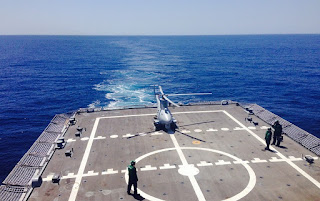
By Ben Ho Wan Beng Introduction   “Unmanned aviation” has been a buzzword in the airpower community during recent years with the growing prevalence of unmanned systems to complement and in some cases replace peopled ones in key roles like intelligence, surveillance and reconnaissance (ISR). Insofar as unmanned aerial vehicles (UAVs) are increasingly used for strike, their dominant mission is still ISR because of the fledging state of pilotless technology. This is especially the case for sea-based drones, which are generally less capable than their brethren ashore. That said, several littoral navies have jumped on the shipborne UAV bandwagon owing to its relative utility and cost-effectiveness. [1]  And with access to such platforms, how would these entities be effected during combat? For littoral nations without an aerial maritime ISR capability in the form of maritime patrol aircraft (or only having a limited MPA capability), the sea-based drone can make up for t...

UAVs Compete for Dominance in the Arctic

Image
The Arctic Circle is a complex environment of harsh climate, shifting ice flows, and remote, barren wastelands. Much ado has been made of late of the region's potential for alternative shipping routes, resource extraction, and of course, the expanded military presence usually associated with those activities. The vast distances and unforgiving temperatures of Arctic air and waters make unmanned aerial vehicles ideal for military reconnaissance there. Practically all of the countries which border Arctic seas have some sort of UAV programs underway. One of the primary goals of Canada's troubled  Joint Uninhabited Surveillance and Target Acquisition System (JUSTAS) project was to conduct Northern Patrols over the country's Arctic territory. In addition to surveilling the area, the yet to be determined type of JUSTAS UAVs will be required to drop search and rescue kits to distressed mariners.  The program's delays have been largely due to competing requirements bet...

Where is the U.S. Navy Going To Put Them All?

Image
Part 1: More Drones Please. Lot’s and Lot’s of Them! Guest Post by Jan Musil Sketch by Jan Musil. Hand drawn on quarter-inch  graph paper. Each square equals twenty by twenty feet. Recent technological developments have provided the U.S. Navy with major breakthroughs in unmanned carrier landings with the X-47B . A public debate has emerged over which types of drones to acquire and how to employ them. This article suggests a solution to the issue of how to best make use of the new capabilities that unmanned aircraft and closely related developments in UUVs bring to the fleet. The suggested solution argues for taking a broader look at what all of the new aerial and underwater unmanned vehicles can contribute, particularly en masse. And how this grouping of new equipment can augment carrier strike groups. In addition, there are significant opportunities to revive ASW hunter killer task forces, expand operational capabilities in the Arctic, supplement our South China Sea an...

Airborne Over The Horizon Targeting Options to Enable Distributed Lethality

Image
This article was submitted by guest author Michael Glynn for CIMSEC’s Distributed Lethality week.  Reprinted with permission from the Center for International Maritime Security. The Navy’s surface warfare community is committed to remedying its lack of anti-surface warfare (ASuW) punch with Distributed Lethality. “If it floats, it fights,” is the rallying cry.[1] Dispersed forces operating together pose challenges for an adversary, but also create targeting difficulties we must solve. The detection range of shipboard sensors is limited by their height above the waterline and the curvature of the earth. Since it appears doubtful leaders would call on a ship to steam into visual range of adversaries, airborne assets are most likely to provide over the horizon (OTH) targeting. In a January 2015 article in Proceedings, Vice Admiral Rowden, Rear Admiral Gumataotao, and Rear Admiral Fanta reference “persistent organic” air assets as key enablers of Distributed Lethality.[2]...

UCLASS Requirements – Some Contrarian Viewpoints

Image
By Chris Rawley With the U.S. Navy’s UCLASS request for proposal delayed while classified  requirements are again reviewed, a spectrum of opinions about the program have percolated into the public light.   In his recent letter to the Secretary of Defense, Senator John McCain reinforced what seems to be the prevailing view that the Navy needs a very capable (and likely expensive) aircraft, with "a n unrefueled endurance several times that of manned fighters; a refueled mission endurance measured in days; broadband, all-aspect radar cross-section reduction sufficient to find and engage defended targets; and the ability to carry internally a flexible mix of up to 4,000 pounds of strike payload."   Navy SEAL Captain Robert Newson recently advocated a lower end/lower cost UCLASS supported by  the “small, smart, and many” argument.   Blogger C DR Salamander also chimed in with a pragmatic  argument that UCLASS  requirements creep could le...