Posts

Showing posts with the label ASW

Hybrid Drones - the Advantages of Operating in Multiple Domains
Image
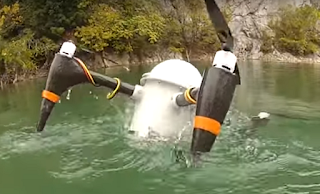
Classifying unmanned maritime systems by their operating domain: air, surface, or underwater - is both convenient and intuitive. But recently, navy and industry researchers have begun to explore the advantages of platforms that can operate in two domains, muddying the nomenclature.  In the past year, several prototype multi-domain unmanned vehicles have been introduced.   CRACUNS The most popular combination of these hybrid drones is the air/sub-surface mixture - UAVs that float or swim.  Johns Hopkins University Applied Physics Laboratory in Laurel, Maryland introduced t he Corrosion Resistant Aerial Covert Unmanned Nautical System ( CRACUNS ), a submersible UAV designed to operate in the littorals which can be launched from a fixed position underwater or from an unmanned underwater vehicle (UUV). Rutger University's entry into the fray of flying/swimming drones is the Naviator , which can actually maneuver (sort of) underwater before surfacing and taking off....

Where is the U.S. Navy Going To Put Them All? (Part 2)

Image
Part 2: UUVs, Fire Scouts and buoys and why the Navy needs lot’s of them. Guest post  by Jan Musil. Sketch by Jan Musil. Hand drawn on  quarter-inch graph paper. Each  square equals twenty by twenty feet. This article, the second of the series, lays out a suggested doctrine of use for the UUVs and Fire Scouts that have already been developed. It is an incremental strategy, primarily calling for using what the Navy already has in hand, adding use of buoys in quantity combined with appropriate doctrinal changes and vigorously applying the result to the ASW mission. In getting this program underway the U.S. Navy can utilize existing sensors, whether for prosecuting ASW, developing sonar projections of the water below, including occasional deep diving missions and whatever else we find a need for the UUV to do. In practice though, generating useful results is far easier to accomplish if the UUV is routinely, though not exclusively, used with a tether so the data...

Worth a Listen: CIMSEC's Unmanned Naval Vessel Podcast

Image
The Center for International Maritime Security's most recent "Sea Control" podcast  features an interesting and wide-ranging discussion on future unmanned and optionally-manned naval systems.  Much of the discussion revolves around the challenges of operating large surface ships without manpower, to include some of the more mundane functions, such as maintenance. Alex Clarke, of the Phoenix Think Tank, proposed the concept of an "unmanned wingman" for Offshore Patrol Vessels performing remote operations.  He also mentioned the possibility of USVs taking on the role of the T-AGOs towed array sonar operations for anti-submarine warfare. Essentially, this concept mirrors what DARPA's ACTUV  program intends to do.  Other topics of consideration are unmanned alternatives to aircraft carriers, the difficult question of whether destroying an unmanned vehicle is an act of war, and command and control schemes.