Posts

Showing posts with the label UUV

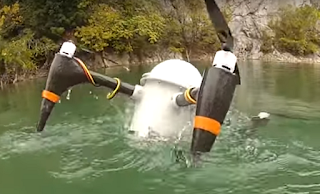
Hybrid Drones - the Advantages of Operating in Multiple Domains
Image
Classifying unmanned maritime systems by their operating domain: air, surface, or underwater - is both convenient and intuitive. But recently, navy and industry researchers have begun to explore the advantages of platforms that can operate in two domains, muddying the nomenclature.  In the past year, several prototype multi-domain unmanned vehicles have been introduced.   CRACUNS The most popular combination of these hybrid drones is the air/sub-surface mixture - UAVs that float or swim.  Johns Hopkins University Applied Physics Laboratory in Laurel, Maryland introduced t he Corrosion Resistant Aerial Covert Unmanned Nautical System ( CRACUNS ), a submersible UAV designed to operate in the littorals which can be launched from a fixed position underwater or from an unmanned underwater vehicle (UUV). Rutger University's entry into the fray of flying/swimming drones is the Naviator , which can actually maneuver (sort of) underwater before surfacing and taking off....

Unmanned Maritime Systems Operations and Maintenance Lifecycle Costs

Image
by Dr. Diana Angelis, NPS Faculty, diangeli(at) nps.edu  The Navy currently has a number of Unmanned Maritime Systems (UMS) that perform a variety of missions including mine countermeasures, maritime security, hydrographic surveying, environmental analysis, special operations, and oceanographic research. While these unmanned systems were rapidly developed and fielded to meet immediate warfighter needs, some of the systems have not been subjected to the normal cost reviews associated with programs of record and in many cases the data required to develop rigorous cost models is limited or unavailable. As a result, the total ownership cost of unmanned maritime systems is not well defined, particularly the costs associated with operations and support. Dr. Diana Angelis and Mr. Steve Koepenick from SPAWAR have been working on a CRUSER funded project to better understand UMS lifecycle costs with an emphasis on the operations and support costs associated with unmanned underwater v...

Multi-Domain Unmanned Systems Implementation Creates Comprehensive Maritime Situational Awareness

Image
by Morgan Stritzinger, Public Relations Specialist, Textron Systems, mstritzi(at)textronsystems.com The collaboration of unmanned aircraft systems (UAS), unmanned surface vehicles (USVs) and unmanned underwater vehicles (UUV) extends relative reach, and therefore the operational footprint. The unmanned aircraft and USV work together to extend data link ranges, and the USV can carry, deploy and recover the UUV, thereby extending its range and providing a safer environment for the host vessel. Extending mission capabilities is critical to efficient and effective maritime missions, creating situational awareness that delivers actionable data and value. Unmanned systems are best suited for tasks too “dull, dirty or dangerous” for their manned counterparts and are a pertinent complementary system to manned asset efforts. This includes repetitive tasks that are more costly for humans to perform or represent opportunity for human error, situations in extreme weather and environmental co...

Where is the U.S. Navy Going To Put Them All? (Part 2)

Image
Part 2: UUVs, Fire Scouts and buoys and why the Navy needs lot’s of them. Guest post  by Jan Musil. Sketch by Jan Musil. Hand drawn on  quarter-inch graph paper. Each  square equals twenty by twenty feet. This article, the second of the series, lays out a suggested doctrine of use for the UUVs and Fire Scouts that have already been developed. It is an incremental strategy, primarily calling for using what the Navy already has in hand, adding use of buoys in quantity combined with appropriate doctrinal changes and vigorously applying the result to the ASW mission. In getting this program underway the U.S. Navy can utilize existing sensors, whether for prosecuting ASW, developing sonar projections of the water below, including occasional deep diving missions and whatever else we find a need for the UUV to do. In practice though, generating useful results is far easier to accomplish if the UUV is routinely, though not exclusively, used with a tether so the data...

Where is the U.S. Navy Going To Put Them All?

Image
Part 1: More Drones Please. Lot’s and Lot’s of Them! Guest Post by Jan Musil Sketch by Jan Musil. Hand drawn on quarter-inch  graph paper. Each square equals twenty by twenty feet. Recent technological developments have provided the U.S. Navy with major breakthroughs in unmanned carrier landings with the X-47B . A public debate has emerged over which types of drones to acquire and how to employ them. This article suggests a solution to the issue of how to best make use of the new capabilities that unmanned aircraft and closely related developments in UUVs bring to the fleet. The suggested solution argues for taking a broader look at what all of the new aerial and underwater unmanned vehicles can contribute, particularly en masse. And how this grouping of new equipment can augment carrier strike groups. In addition, there are significant opportunities to revive ASW hunter killer task forces, expand operational capabilities in the Arctic, supplement our South China Sea an...

Navy's Planned Patrol Boat Fleet Will Distribute More Mine Clearance Capability

Image
Navy Minesweeping Boats (MSBs) cleared mines and fought their way through Vietnamese waters. Sea mines are simple, affordable, and prolific, yet one of the most lethal weapons of naval warfare in the past 50 years.  Countering this threat remains a significant challenge for even the most advanced navies. The eleven remaining Avenger class Mine Counter Measures ships in the U.S. Navy's fleet are divided between two forward deployed home ports, Bahrain, and Sasebo, Japan.  These single purpose ships will be gradually phased out in favor of new unmanned, off-board mine clearance technology embarked on a variety of platforms, such as the Littoral Combat Ship.   The Navy is also planning for smaller craft, such as the MK VI patrol boat to carry Unmanned Underwater Vehicles (UUVs) for mine clearance.  During the early days of Operation Iraqi Freedom, the Navy utilized small UUVs launched from the shore and inflatable zodiacs to find mines in Iraq's rivers. More rec...

Lethal Autonomy in Autonomous Unmanned Vehicles

Image
Guest post written for UUV Week by Sean Walsh. Should robots sink ships with people on them in time of war? Will it be normatively acceptable and technically possible for robotic submarines to replace crewed submarines? These debates are well-worn in the UAV space. Ron Arkin’s classic work  Governing Lethal Behaviour in Autonomous Robots  has generated considerable attention since it was published six years ago in 2009. The centre of his work is the “ethical governor” that would give normative approval to lethal decisions to engage enemy targets. He claims that International Humanitarian Law (IHL) and Rules of Engagement can be programmed into robots in machine readable language. He illustrates his work with a prototype that engages in several test cases. The drone does not bomb the Taliban because they are in a cemetery and targeting “cultural property” is forbidden. The drone selects an “alternative release point” (i.e. it waits for the tank to move a certain distance)...

UUVs as Stealthy Logistics Platforms

Image
Guest post for UUV Week by  Steve Weintz. As potential adversaries sharpen their abilities to deny U.S. forces the freedom to maneuver, they concurrently constrain America's traditional strength in supporting expeditionary power. Sea-bases bring the logistical "tail" closer to the expeditionary "teeth," but they must stay outside the reach of A2/AD threats. Submarines remain the stealthiest military platform and will likely remain so for some time to come. In addition to their counter-force and counter-logistics roles, subs have seen limited service as stealth cargo vessels. History demonstrates both the advantages and limitations of submarines as transports. Submarine troop carriers, such as those used in SOF operations, are distinct from submarine freighters; the submarine's role in supply and sustainment is addressed here. Unmanned Underwater Vehicles (UUVs) will revolutionize minesweeping, intelligence collection, and reconnaissance. But they may als...