Posts

Showing posts with the label BAMS

UAVs Compete for Dominance in the Arctic

Image
The Arctic Circle is a complex environment of harsh climate, shifting ice flows, and remote, barren wastelands. Much ado has been made of late of the region's potential for alternative shipping routes, resource extraction, and of course, the expanded military presence usually associated with those activities. The vast distances and unforgiving temperatures of Arctic air and waters make unmanned aerial vehicles ideal for military reconnaissance there. Practically all of the countries which border Arctic seas have some sort of UAV programs underway. One of the primary goals of Canada's troubled  Joint Uninhabited Surveillance and Target Acquisition System (JUSTAS) project was to conduct Northern Patrols over the country's Arctic territory. In addition to surveilling the area, the yet to be determined type of JUSTAS UAVs will be required to drop search and rescue kits to distressed mariners.  The program's delays have been largely due to competing requirements bet...

Drones on the Frontlines of the South China Sea

Image
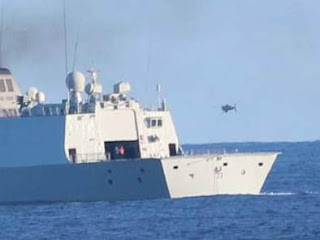
Chinese UAV imagery of Senkakus More than one war has started over the control of a group of isolated rocks in the middle of the ocean.  Tensions over disputed East China Sea islands called the Diaoyu by China and the Senkaku by Japan could someday precipitate skirmishes on or over the sea, if not a larger conflict.  It may very well possible that the first shots fired in any sort of combat over these islands will involve growing number of maritime unmanned aerial vehicles (UAVs) flying in the area.  Late in 2013, China established an  air defense zone  (ADIZ) over portions of the East China Sea.  Further south, near the disputed Spratlys, similar issues exists. To help enforce their claims over these areas, China is building a string of 11 drone bases along its coast by 2015. China has operated what is likely a variant of the S-100  rotary wing UAV off PLA(N) ships. China's Coast Guard, which is really the PRC's first line of defense ...

Using Unmanned Systems For Anti-Piracy

Image
Second Prize Winner, 2015 CIMSEC High School Essay Contest (reprinted with the permission of CIMSEC ). The issue I would like to address in this essay is piracy. Piracy has been a threat to the safety of the seas since the seas were first used for transport and it has been a danger ever since. From the Barbary Corsairs to the privateers of the Caribbean, pirates have found ways to succeed or even thrive no matter the situation. For years pirate skiffs from Somalia have been attacking marine traffic to hold the ships and/or their crews for ransom. These brazen attacks have drawn the attention of the media and even, in the case of the Maersk Alabama, Hollywood. Of course any security issue that comes to the attention of the general public has first passed through the halls of numerous defense ministries across the globe so it should come as no surprise that before, during, and after these events, efforts were made by various navies including the US Navy and a coalition task ...

Unmanned ISR and Future Air Wing Composition

Image
According to Defense News , the U.S. Navy's inventory of manned intelligence, surveillance, and reconaissance (ISR) platforms - land-based P-3 Orion and EP-3 Aries - will be cut by more than a quarter over the next few years.  The current consolidations are not the first time in recent history the Navy has trimmed ISR capability.  As late as  the 1990s, a typical carrier air wing deployed with a number of organic platforms capable of collecting intelligence, including tactical aircraft such as the F-14 with the Tactical Airborne Reconnaissance Pod System (TARPS) and ES-3A Shadows for electronic signals intercept (ELINT).  These aircraft were supplemented by a robust ground-based P-3 fleet along with numerous FLIR and radar capable helicopters on smaller cruisers and destroyers. Today's remaining manned aircraft, such as the venerable, but still effective, P-3s are today often found flying over-la...

Naval Drones 2012 Year in Review

Image
What were the top stories in unmanned naval technology during 2012?  What follows is a completely unscientific count-down of the major events related to naval drones over the past year: 10. The Japanese Maritime Self Defense Force captures a flock of Schiebel S-100 UAVs operating from PLAN frigate on film. Camcopter variant operating off Chinese Frigate. 9. SAIC was awarded a contract for the planned DARPA ASW drone , Anti-Submarine Warfare (ASW) Continuous Trail Unmanned Vessel (ACTUV), which will autonomously hunt and track diesel subs. SAIC rendering of ACTUV's unique tri-maran hull form. 8. DARPA *almost* conducts air-to-air refueling of UAVs .  Trials actually transferring fuel were postponed due to BAMS-D crash (See #3). RQ-4 Global Hawks in formation for DARPA drogue and probe refueling demonstration. 7. Kongsberg Maritime's Hydroid subsidiary REMUS mine-hunting AUVs proliferate gl...

U.S. CNO Makes Unmanned Systems a Priority

Image
PALMDALE, Calif. (Aug. 8, 2012) Chief of Naval Operations (CNO) Adm. Jonathan Greenert observes a fly-by demonstration of a Predator C Avenger unmanned aerial vehicle. (U.S. Navy photo by Mass Communication Specialist 1st Class Peter D. Lawlor/Released) In a nod to maritime tradition, the new Chief of Naval Operations set forth a " Navigation Plan " with budgetary priorities and a route to achieve the vision he set in the " Sailing Directions " for 2013-2017.  Admiral Greenert's prioritization of unmanned systems for the U.S. fleet in these documents is anything but archaic.  Seven of the CNO's 34 budget focus areas directly address unmanned systems, including: "Increase near-term mine warfare capability with Quickstrike mines; the Seafox Mine Neutralization System ; upgraded MCM-1 class ship sonar, hull, and engineering upgrades; and Unmanned Underwater Vehicles (UUV) for shallow and bottom mine detection. Improve near-term cap...