Posts

Flying Miniature Quad-Rotor Unmanned Aerial Systems over the Arctic Ocean
Image
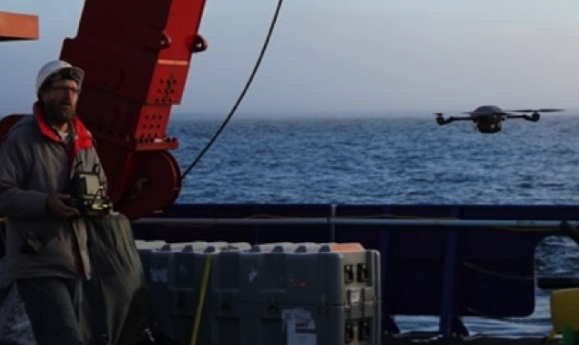
by Peter Guest, NPS Faculty, pguest(at)nps.edu This article describes meteorological measurements over the Arctic Ocean using a Miniature Quad-Rotor Unmanned Aerial System (MQRUAS). With support from the CRUSER program, the author and students have been testing the concept of using MQRUASs as platforms for measurements of temperature, humidity and pressure in the lower atmosphere using a radiosonde as a sensor. The author performed a series of tests at Camp Roberts that involved flying the InstantEye MQRUAS alongside a calibrated meteorological tower to test the accuracy of the measurements. These tests determined that such measurements were of sufficient accuracy and reliability to be used for scientific and operational studies of atmospheric structure near the surface. Figure 1: InstantEye taking off from the fantail of the R/V Sikuliaq An Office of Naval Research directed research initiative entitled “Sea State and Boundary Layers in the Emerging Arctic Ocean” (abbreviated ...

Write for Naval Drones

Image
Do you enjoy writing? Are you interested in discussing the latest in unmanned systems and how they will impact future naval warfare? Great, because we're looking for guest contributors.  The range of topics we will publish here is broad, from systems and technology, to operational concepts, to the cultural changes that will be required to integrate drones into maritime warfare. Please send your submissions to  info@navaldrones.com  for consideration.  Short form blog posts (500-800 words) or longer articles are acceptable.  International contributors are welcome.  Get your ideas in front of our large and growing global audience of industry and naval professionals.

Naval Drones - What to Expect in 2016

Image
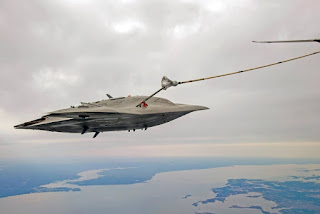
Looking Back at 2015  Our highly unscientific Twitter poll below shows what some readers thought were the most significant events in unmanned naval systems for 2015. Most significant naval drone story of 2015? — Naval Drones (@NavalDrones) December 28, 2015 For details on these stories, see:  X-47B Refueling ,  Russian Kanyon Nuclear UUV ,  UCLASS RFP X-47B takes on fuel And Forward to 2016 What follows are our expectations, hunches, and just wild guesses of the major developments to watch for in naval unmanned systems industry during the coming year. Sanity Prevails  - After spending nearly a billion dollars and more than two decades developing the troubled  Remote Minehunting System , the U.S. Navy will cancel the program.  Lockheed's RMS, which was intended to be one of the Littoral Combat Ship's key mission packages, will be replaced by one or more of the growing number of versatile, less expensive mine-countermeasure UUVs. Also,...

Development and Testing of the Aqua-Quad

Image
by Dr Kevin Jones, NPS Faculty, kdjones<at>nps.edu  Under CRUSER funding, a new energy-independent, ultra-long endurance, hybrid-mobility unmanned system has been under development called the Aqua-Quad. It is a concept platform that combines an ocean drifter with a quad-rotor air vehicle, and is intended to be a “launch and forget” asset, typically deployed in small groups or flocks that work as a team to more efficiently meet mission goals. While there are many mission sets where the Aqua-Quad might be advantageous, one in particular, underwater tracking with passive acoustic sensors, was previously addressed in simulation by LT Dillard (MAE, 2014). This has led to current work by LT Cason (USW, 2015), also with contributions by LT Fauci (SE, 2015). Flyable prototype with lower shell removed and feet attached  (image courtesy of CRUSER) As seen in the figure, a 20-cell photovoltaic (PV) array is distributed around the four propeller disks. These monocrystall...

Unmanned Maritime Systems Operations and Maintenance Lifecycle Costs

Image
by Dr. Diana Angelis, NPS Faculty, diangeli(at) nps.edu  The Navy currently has a number of Unmanned Maritime Systems (UMS) that perform a variety of missions including mine countermeasures, maritime security, hydrographic surveying, environmental analysis, special operations, and oceanographic research. While these unmanned systems were rapidly developed and fielded to meet immediate warfighter needs, some of the systems have not been subjected to the normal cost reviews associated with programs of record and in many cases the data required to develop rigorous cost models is limited or unavailable. As a result, the total ownership cost of unmanned maritime systems is not well defined, particularly the costs associated with operations and support. Dr. Diana Angelis and Mr. Steve Koepenick from SPAWAR have been working on a CRUSER funded project to better understand UMS lifecycle costs with an emphasis on the operations and support costs associated with unmanned underwater v...

Multi-Domain Unmanned Systems Implementation Creates Comprehensive Maritime Situational Awareness

Image
by Morgan Stritzinger, Public Relations Specialist, Textron Systems, mstritzi(at)textronsystems.com The collaboration of unmanned aircraft systems (UAS), unmanned surface vehicles (USVs) and unmanned underwater vehicles (UUV) extends relative reach, and therefore the operational footprint. The unmanned aircraft and USV work together to extend data link ranges, and the USV can carry, deploy and recover the UUV, thereby extending its range and providing a safer environment for the host vessel. Extending mission capabilities is critical to efficient and effective maritime missions, creating situational awareness that delivers actionable data and value. Unmanned systems are best suited for tasks too “dull, dirty or dangerous” for their manned counterparts and are a pertinent complementary system to manned asset efforts. This includes repetitive tasks that are more costly for humans to perform or represent opportunity for human error, situations in extreme weather and environmental co...

UCLASS: Breaking the Analysis Paralysis

Image
As the requirements definition for the U.S. Navy's unmanned carrier aircraft ( UCLASS )  program to de velop a long duration, carrier-based unmanned air system sits stalled awaiting an  ongoing Office of Secretary of Defense (OSD) ISR UAV review due sometime this fiscal year , one thing is sure: the longer the decision is delayed, the later this important capability - in whatever form it eventually may take - will hit the fleet.  The aircraft's original initial operating capability has already slipped from 2017 to no earlier than 2023. Possibly in an attempt to break the ongoing analytical logjam, informed naval analysts have begun to suggest alternatives to the binary decision of simply buying a UCLASS specialized in ISR and light strike or one that is optimized for long-range, penetrating strike. Bryan McGrath, Deputy Director of the Center for American Seapower, came to realize the importance of a long-range, carrier-based scouting aircraft while researching the ...