Posts

Puma Goes to Sea (Again)

Image
U.S. 5TH FLEET AREA OF RESPONSIBILITY (Sept. 25, 2012) U.S. Navy Senior Chief Engineman Bradley Williamson, left, and Engineman 1st Class Michael Lamb assigned to Riverine Squadron Two, Detachment Three, conducts pre-flight checks on the Puma AE (Pointer Upgraded Mission Ability – All Environment) aircraft aboard Royal Fleet Auxiliary amphibious landing dock vessel RFA Cardigan Bay (L3009), as Royal Navy minehunter HMS Shoreham (M112) operates nearby. The U.S. Navy is currently testing Puma AE for land and shipboard operations in the U.S. 5th Fleet Area of Responsibility (AOR). U.S. 5th Fleet's mission is to conduct maritime security operations, defeat violent extremism and strengthen partner nations' maritime capabilities in order to promote security and stability in the U.S. Central Command AOR. (Royal Navy photo/Released) Continuing a recent string of articles on unmanned air vehicles, this month's US Naval Institute's Proceedings features an article (member...

Unmanned ISR and Future Air Wing Composition

Image
According to Defense News , the U.S. Navy's inventory of manned intelligence, surveillance, and reconaissance (ISR) platforms - land-based P-3 Orion and EP-3 Aries - will be cut by more than a quarter over the next few years.  The current consolidations are not the first time in recent history the Navy has trimmed ISR capability.  As late as  the 1990s, a typical carrier air wing deployed with a number of organic platforms capable of collecting intelligence, including tactical aircraft such as the F-14 with the Tactical Airborne Reconnaissance Pod System (TARPS) and ES-3A Shadows for electronic signals intercept (ELINT).  These aircraft were supplemented by a robust ground-based P-3 fleet along with numerous FLIR and radar capable helicopters on smaller cruisers and destroyers. Today's remaining manned aircraft, such as the venerable, but still effective, P-3s are today often found flying over-la...

Investing in Unmanned Naval Systems

The market for unmanned naval systems is growing by leaps and bounds.  Between air, surface, and subsurface platforms, a variety of companies big and small are competing for contracts to meet the demand of navies across the globe.  To provide some perspective on this market, NavalDrones has analyzed the performance of a theoretical portfolio of 12 publically-traded stocks  during 2012.  These stocks range from well-entrenched defense giants like Lockheed Martin( LMT ) and Boeing( BA ) to mid-sized companies producing sensors and other components for naval drones  including Griffon ( GFF ) and Cubic ( CUB ).  With $1,000 invested equally in each of the stocks at the beginning of 2012, the portfolio's initial investment of $12,000 would have been valued at $13,196.12 at the market's close on December 31, for a total return (inclusive of dividends) of 9.97%.  In comparison wit...

Dronenets and Navy Logistics

Futurist John Robb has posted some interesting ideas on a concept called Dronenet , where he envisions a peer-to-peer logistics service using small UAVs.  The primary constraints to this sort of idea taking off in the civilian sector are hardware and network standards, plus, some likely hesitance on the part of the general public to have quadrotors full of Chinese food deliveries zooming over their neighborhoods. On the military side, we've seen a rudimentary version of a dronenet with the Marine Corps' apparently successful K-Max  VTOL UAV logistics experiment in Afghanistan.  During the 1990s, the K-Max was used by the U.S. Navy as a contractor-operator aircraft for vertical replenishment at sea.  Every day, the Navy moves tons of ammunition, food, and other heavy stores via sling-load pallet from replenishment ships.  While smaller, higher value - and time critical deliveries - such as circuit cards for weapons s...

Naval Drones 2012 Year in Review

Image
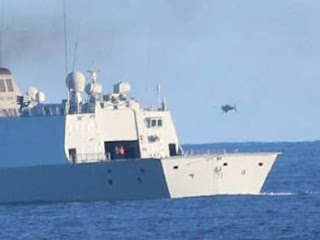
What were the top stories in unmanned naval technology during 2012?  What follows is a completely unscientific count-down of the major events related to naval drones over the past year: 10. The Japanese Maritime Self Defense Force captures a flock of Schiebel S-100 UAVs operating from PLAN frigate on film. Camcopter variant operating off Chinese Frigate. 9. SAIC was awarded a contract for the planned DARPA ASW drone , Anti-Submarine Warfare (ASW) Continuous Trail Unmanned Vessel (ACTUV), which will autonomously hunt and track diesel subs. SAIC rendering of ACTUV's unique tri-maran hull form. 8. DARPA *almost* conducts air-to-air refueling of UAVs .  Trials actually transferring fuel were postponed due to BAMS-D crash (See #3). RQ-4 Global Hawks in formation for DARPA drogue and probe refueling demonstration. 7. Kongsberg Maritime's Hydroid subsidiary REMUS mine-hunting AUVs proliferate gl...

Unmanned Systems for EM-Cyber Warfare

Image
In the December 2012 version of Proceedings , the U.S. Chief of Naval Operations discusses how the electromagnetic (EM) spectrum and cyber warfare have become intertwined into a single EM-cyber environment, one which will will have significant implications for future war-fighting. The CNO argues that the two primary keys to commanding the EM-cyber domain are a knowledge of the environment and agility.  Naval unmanned systems' role in both aspects of this rapidly evolving warfare domain will grow in importance. The CNO writes that knowing the EM-cyber environment requires the ability to "detect, assess,and predict in real time the activities going on in that domain." Because in most cases, unmanned systems are less expensive to procure than manned platforms, drones dedicated to electronic and cyber warfare can be deployed in large numbers, surveying a wider geographic area.  Additionally, UAVs are rapidly and easily upgrade...

SAIC Reveals New Details on ASW Drone

Image
Science Applications International Corporation (SAIC) has released an updated promotional video on the Anti-Submarine Warfare (ASW) Continuous Trail Unmanned Vessel (ACTUV), a DARPA Tactical Technology Office project to develop an autonomous surface vehicle. ACTUV is specifically designed to conduct long duration autonomous tracking missions against diesel submarines. The video reveals some interesting new details on the awkwardly-acronymed vessel. The computer-generated vignette shows ACTUV working in conjunction with other platforms to track and prosecute submarines using onboard sensors. These include a mid-frequency active/passive sonar mounted in a pod under the vessel's keel, two high frequency active sonars for localization, and a total-field magnetometer array along the ACTUV's hull for close-in tracking. A very high frequency sonar will then use acoustic imaging to classify the sub. Also interesting are the other possible missions ACTUV could conduct which includ...