Posts

Naval Drones 2012 Year in Review
Image
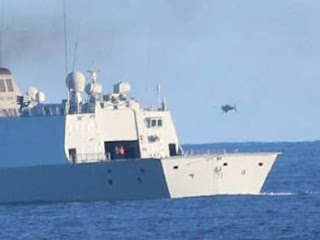
What were the top stories in unmanned naval technology during 2012?  What follows is a completely unscientific count-down of the major events related to naval drones over the past year: 10. The Japanese Maritime Self Defense Force captures a flock of Schiebel S-100 UAVs operating from PLAN frigate on film. Camcopter variant operating off Chinese Frigate. 9. SAIC was awarded a contract for the planned DARPA ASW drone , Anti-Submarine Warfare (ASW) Continuous Trail Unmanned Vessel (ACTUV), which will autonomously hunt and track diesel subs. SAIC rendering of ACTUV's unique tri-maran hull form. 8. DARPA *almost* conducts air-to-air refueling of UAVs .  Trials actually transferring fuel were postponed due to BAMS-D crash (See #3). RQ-4 Global Hawks in formation for DARPA drogue and probe refueling demonstration. 7. Kongsberg Maritime's Hydroid subsidiary REMUS mine-hunting AUVs proliferate gl...

Unmanned Systems for EM-Cyber Warfare

Image
In the December 2012 version of Proceedings , the U.S. Chief of Naval Operations discusses how the electromagnetic (EM) spectrum and cyber warfare have become intertwined into a single EM-cyber environment, one which will will have significant implications for future war-fighting. The CNO argues that the two primary keys to commanding the EM-cyber domain are a knowledge of the environment and agility.  Naval unmanned systems' role in both aspects of this rapidly evolving warfare domain will grow in importance. The CNO writes that knowing the EM-cyber environment requires the ability to "detect, assess,and predict in real time the activities going on in that domain." Because in most cases, unmanned systems are less expensive to procure than manned platforms, drones dedicated to electronic and cyber warfare can be deployed in large numbers, surveying a wider geographic area.  Additionally, UAVs are rapidly and easily upgrade...

SAIC Reveals New Details on ASW Drone

Image
Science Applications International Corporation (SAIC) has released an updated promotional video on the Anti-Submarine Warfare (ASW) Continuous Trail Unmanned Vessel (ACTUV), a DARPA Tactical Technology Office project to develop an autonomous surface vehicle. ACTUV is specifically designed to conduct long duration autonomous tracking missions against diesel submarines. The video reveals some interesting new details on the awkwardly-acronymed vessel. The computer-generated vignette shows ACTUV working in conjunction with other platforms to track and prosecute submarines using onboard sensors. These include a mid-frequency active/passive sonar mounted in a pod under the vessel's keel, two high frequency active sonars for localization, and a total-field magnetometer array along the ACTUV's hull for close-in tracking. A very high frequency sonar will then use acoustic imaging to classify the sub. Also interesting are the other possible missions ACTUV could conduct which includ...

Drones of the Navy SEALs

Image
The mystique of Navy SEALs has been heavily celebrated in the media and films due to recent real world exploits.  Yet Naval Special Warfare (NSW) sailors have been heavily engaged in combat operations for more than eleven consecutive years.  Warfare is still a decidely human endeavor, and America's naval special warriors are quick to embrace the truth that "humans are more important than hardware." Nevertheless, today's SEALs, Special Warfare Combat Crewmen, and other supporting personnel in the NSW community have benefited greatly from technology, which increasingly includes unmanned systems. Two primary realizations within the NSW community drove the rapid introduction of UAVs for combat operations in Southwest and Central Asia.  The first realization was that even the best shooters in the world were ineffective if they were unable to locate their targets.  Simply, UAVs are a force multiplier for SEALs and enable an exponential increase in the...

Sea-Based Drones & the Future of Counterterrorism

Image
In a recent Washington Post editorial , Kimberly and Frederick Kagan take a solid position on why the U.S. should maintain a troop presence to support counterterrorism operations in Afghanistan post-2014. The bulk of their argument for continued U.S. ground deployments revolves around the tyranny of distance’s impact on future counterterrorism (CT) operations against the al Qaeda (AQ) network: North Waziristan is more than 600 miles from the nearest coastline; the other sanctuaries are farther. The U.S. Air Force reports that armed Predator drones have a range of about 1,150 miles - not enough to get to Waziristan and back again from the coast, much less to orbit and observe a target. Special mission units would have to parachute from transport aircraft because no helicopter in the U.S. inventory can fly that far. But they could not return because aircraft cannot land in the mountains of Eastern Afghanistan or in Pakistan. Manned aircraft can drop precision weapons on targets in...

Navy Looks to Small Business to Solve RMS Problems‏

Image
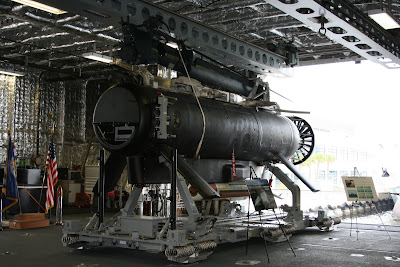
Lockheed Martin's troubled  AN/WLD-1 Remote Minehunting System is the key component of the U.S. Navy's Littoral Combat Ship Mine Counter-measures Mission Package (MCM MP) and   has been under development for nearly two decades.   The heart of the system is a diesel-powered, semi-submersible Remote Multi-Mission Vehicle (RMMV)  designed to tow a variable depth mine-hunting sonar.  AN/WLD-1 aboard USS Freedom (LCS-2) Testing on RMS prototypes began in 1994, but the system has yet to mature to full operational status.  In an effort to work some of the kinks out of RMS, the Navy's Program Executive Officer for Littoral Combat Ships (PEO LCS)  has sought the assistance of industry via the most recent Small Business Innovation Research ( SBIR ) program solicitation.     A solicitation released by the Remote Minehunting System Program Office (PMS 403) entitled " Anticorrosion Solution for Re...

A Little Friday Humor

Image
U.S. Navy Blue Angels Demonstration Team, Circa 2020. H/T: MJ