Posts

The Future of Sea-Air Drones and Protecting Maritime Assets
Image
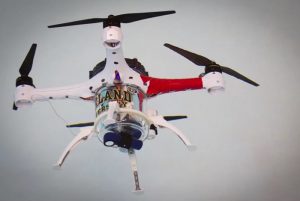
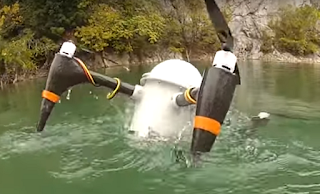
By Jack Whitacre What are some of the ways the U.S. and other countries could defend maritime assets against swarms of Sea-Air drones? Consider a convoy system with human centered technology, algorithms from nature, and elements of gaming. Oakland University’s Loon Copter works equally well above and below the water’s surface. Photo: Oakland University The FAA estimated that one million drones would be sold during this 2015  holiday season . This estimate was based primarily on the proliferation of flying drones, however new domains of operation may open up soon. Premiering in 2015, the  Loon Copter   proves that, in time, these devices will be capable of traditional aeri al flight, on-wa ter surface operations, and sub-aquatic diving. Embedded Systems Research at Oakland University created the Loon Copter in 2014. In 2016, the design placed third in the  UAE Drones for Good competition . The system works in air as well as in water because the four rotors bal...

Hybrid Drones - the Advantages of Operating in Multiple Domains

Image
Classifying unmanned maritime systems by their operating domain: air, surface, or underwater - is both convenient and intuitive. But recently, navy and industry researchers have begun to explore the advantages of platforms that can operate in two domains, muddying the nomenclature.  In the past year, several prototype multi-domain unmanned vehicles have been introduced.   CRACUNS The most popular combination of these hybrid drones is the air/sub-surface mixture - UAVs that float or swim.  Johns Hopkins University Applied Physics Laboratory in Laurel, Maryland introduced t he Corrosion Resistant Aerial Covert Unmanned Nautical System ( CRACUNS ), a submersible UAV designed to operate in the littorals which can be launched from a fixed position underwater or from an unmanned underwater vehicle (UUV). Rutger University's entry into the fray of flying/swimming drones is the Naviator , which can actually maneuver (sort of) underwater before surfacing and taking off....

Unmanned Systems & Strategic Futures at the Naval War College

Image
The Naval War College remains the center of the U.S. Navy's  foremost strategic thinkers.    Later this month, various experts from the military, academia, and policy communities will convene in Newport for a   maritime strategy symposium .      Some of the presenters will focus on the impact that unmanned vehicles have produced on naval strategy.    From the Naval Post-graduate School, retired Navy Captain Jeff Kline will discuss his paper on   Impacts of the Robotics Age on Naval Force Structure Planning ." Captain Kline’s paper emphasizes the importance of offensive “ payload over platforms ,” in order to overcome impediments to enhancing future force structure. In his words, “This package focus” first is particularly applicable in the electromagnetic and cyber realm. Inexpensive, deposable UAVs employing radar reflectors or chirp jamming may be better delivery platforms for EM “packages” than an F-18 Growler. In the offense...

Mitigating Cosite Interference in UAVs

Image
by Doug King dking(at)polezero.com Military radios must be able to operate in severe cosite interference environments (Figure 1.1 defines cosite interference). Cosite interference is a problem faced by many RF and microwave communications platforms; including Unmanned Systems. Military radios often operate in close proximity to additional radios, giving rise to cosite interference. The following article explains the issues associated with military radios operating in close proximity to additional interferers and how Tunable Filters are utilized in real-time applications. Finally, MPG-Pole/Zero’s recent advances in mitigating cosite interference are summarized. Issues associated with military radios operating in close proximity to additional interferers:  Multiple transmitters coupled to antennas in close proximity create a condition called reverse intermodulation, characterized by the coupling of energy from one transmitter into the antenna of another, creating a simultaneo...

Joint Unmanned Aerial Vehicle (UAV) Swarming Integration Testing

Image
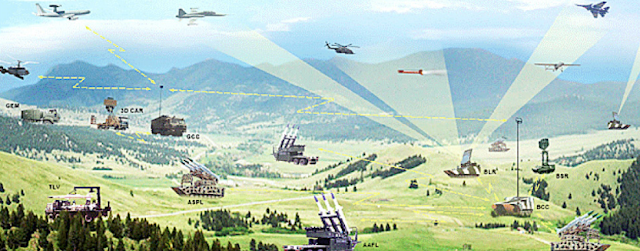
by F. Patrick Filbert, Subject Matter Analyst-UAS, frederic.filbert.ctr(at)pacom.mil As technology improves, so does the capacity to expand a defensive perimeter to ever increasing ranges both horizontally and vertically. Identifying ways to penetrate this perimeter with assets and capabilities that do not require ever more expensive solutions requires creative use of current and emerging technological advances. Potential adversaries understand the United States (U.S.) is extremely technologically advanced with its warfighting systems. This requires a thinking enemy to develop ways to keep America’s advanced systems outside their sphere of influence; specifically, to both deny and create an inability to gain access to specific areas of operation. In the current vernacular, this is called creating an anti-access/area denial (A2/AD) environment which has, as its backbone, advanced integrated air defense systems (IADS). A Bit of History  Being able to provide a “layered” offens...

Flying Miniature Quad-Rotor Unmanned Aerial Systems over the Arctic Ocean

Image
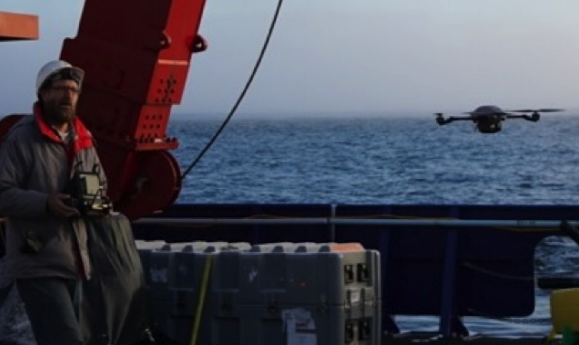
by Peter Guest, NPS Faculty, pguest(at)nps.edu This article describes meteorological measurements over the Arctic Ocean using a Miniature Quad-Rotor Unmanned Aerial System (MQRUAS). With support from the CRUSER program, the author and students have been testing the concept of using MQRUASs as platforms for measurements of temperature, humidity and pressure in the lower atmosphere using a radiosonde as a sensor. The author performed a series of tests at Camp Roberts that involved flying the InstantEye MQRUAS alongside a calibrated meteorological tower to test the accuracy of the measurements. These tests determined that such measurements were of sufficient accuracy and reliability to be used for scientific and operational studies of atmospheric structure near the surface. Figure 1: InstantEye taking off from the fantail of the R/V Sikuliaq An Office of Naval Research directed research initiative entitled “Sea State and Boundary Layers in the Emerging Arctic Ocean” (abbreviated ...

Write for Naval Drones

Image
Do you enjoy writing? Are you interested in discussing the latest in unmanned systems and how they will impact future naval warfare? Great, because we're looking for guest contributors.  The range of topics we will publish here is broad, from systems and technology, to operational concepts, to the cultural changes that will be required to integrate drones into maritime warfare. Please send your submissions to  info@navaldrones.com  for consideration.  Short form blog posts (500-800 words) or longer articles are acceptable.  International contributors are welcome.  Get your ideas in front of our large and growing global audience of industry and naval professionals.