Posts

Unmanned Systems and Distributed Operations: Out of One, Many

Let’s face facts: it appears the U.S. Navy is incapable of building surface combatants, even small ones, for less than about a billion dollars apiece.  Consequently, it is likely the fleet will continue to shrink for the foreseeable future.  Yet it appears that the global demand for surface ship presence remains high for both peacetime operations and as an on-call force for contingency response.  So how can the Navy continue to meet worldwide operational commitments given fewer ships?  The key to maximizing the effectiveness of a declining surface force lies in combining suitable motherships with the latest unmanned warfighting technology.   Unmanned naval systems are rapidly proliferating internationally because they are increasingly capable and cheaper than manned alternatives for certain missions.  To date, sea-based unmanned systems have primarily conducted intelligence, surveillance, reconnaissance and mine countermeasures operations.  But w...

Remote Aviation Technology - What are we Actually Talking About?

In most ‘drone’ conferences, there comes an awkward moment when a panelist realizes that the category ‘drone’ has very little to do with the question that they’re asking. To quote the Renaissance philosopher Inigo Montoya, “I don’t think that word means what you think it means.” In order to improve the remote aviation technology discussion, we need to be clear what we’re actually talking about.  What we should be talking about is ‘remote aviation technology,’ which is simply a fusion of the air and cyber domains through the ubiquitous technologies of datalinks, autopilots, and performance airframes. The fundamental tension is not between risk and responsibility, the two things over which the pop-sci-strat ‘drone’ debate obsesses, but between latency and performance. To the risk point, a military has a moral obligation to reduce risk to its warfighters, so reducing risk through tech is not new; to the responsibility point, professionalism and integrity are the roots for the w...

Swarming Underwater Vehicles, an Update

Image
Bio-inspired robotics research continues to pave the way for future military applications.  In 2012, researchers proved that Autonomous Underwater Vehicles (AUVs), could perform simple swarming functions.   This blog discussed that technology and its implications for naval use in a post here . CoCoRo   (Collective Cognitive Robots) is a consortium of European universities led by the Artificial Life AL at the Department of Zoology at the Karl-Franzens-University Graz engaged in developing autonomous swarms of underwater vehicles to monitor, search, and explore the underwater realm.   The "Jeff" AUV production line. As seen in the above video, their AUVs demonstrate novel underwater communications methods and simple swarming behavior.  CoCoRo is currently building 20 copies of its newer AUV, "Jeff," which can maneuver rapidly underwater and dock to a floating surface station for battery recharging and da...

Drone Motherships – In the Sky!

Image
In a piece in mid-December, our partner site NavalDrones detailed  the U.S. Navy’s solicitation for an unmanned aerial vehicle (UAV) that incorporates Magnetic Anomaly Detector (MAD) sensors. As the article notes, this capability is useful for finding submarines as it “detects changes in the earth’s magnetic field caused by a large metal object” such as yon u-boat. What is perhaps most interesting about the solicitation is that it calls for the UAVs to be expendable and launched from a P-8A Poseidon. The concept of aerial motherhips is by no means new – one only need look back to the glory days of zepplins with biplane detachments, or to the helicarrier in the recent movie The Avengers  to get a sense of the breadth of idea. And the solicitation for the Poseidon doesn’t mark the first go at aircraft-launched UAVs: In 2009, an expendable sonobuoy tube-launched UAV called Coyote was tested out a NOAA’s WP-3D Orion under an Office o...

2013: The Year in Sea Drones

Image
What was the most significant development in unmanned naval systems for 2013?  Blog readers weighed in on this question and more during our survey. Winning by a landslide, with 71% of the responses, was the successful carrier catapult shots and "traps" (arrested landings) of Northrop Grumman's X-47B. ALANTIC OCEAN (Nov. 9, 2013) The experimental X-47B Unmanned Combat Air System Demonstrator (UCAS-D) conducts an arrested landing aboard the aircraft carrier USS Theodore Roosevelt (CVN 71). Theodore Roosevelt is the third carrier to test the tailless, unmanned autonomous air craft's ability to integrate with carrier environment. (US Navy photo By Mass Communication Specialist Seaman Anthony N. Hilkowski/Released) In a distant second, with 19% of the vote, was the proliferation of sea-going rotary wing UAVs. The number of helicopter drones, like this Spanish Skeldar, grew throughout the world's fleets in 2013. Related to #1, the U.S. Navy's ev...

Drones Get MAD

Image
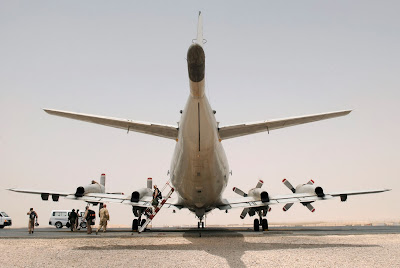
No, despite hype to the contrary, drones aren't getting angry and taking over the world.  But if the U.S. Navy gets its way, a new generation of Unmanned Aerial Vehicles might be getting Magnetic Anomaly Detectors, or MAD.  The Navy has issued two Small Business Innovation Research (SBIR) solicitations related to the incorporation of MAD sensors in UAVs. A MAD is a device normally found on anti-submarine warfare aircraft that detects changes in the earth's magnetic field caused by a large metal object (i.e., a submarine). MAD sensors can be found in the tail of the P3 or towed behind an aircraft, in the case of the Navy's SH-60B helicopters, and are used in the final stages of target prosecution to pinpoint the submarine before weapons release. Business end of a P-3 Orion sub-hunter showing the MAD boom.  The first SBIR solicitation is entitled "Low Magnetic Signature Expendable Unmanned Aerial Vehicle (UAV) for Anti-Submarine Warfare (ASW)" and...

Submarine-launched UAVs: Is the Juice Worth the Squeeze?

Image
Last week, the U.S. Navy announced the launch of a fuel-cell powered Unmanned Aerial Vehicle, the XFC , from a submerged nuclear submarine. Interestingly, XFC is at least the fourth sub-launched UAS the Navy has demonstrated.  Previous efforts date back to 2005 and include the hand-launched  Dragon Eye and FQM-151 and the sail-launched  Buster .  More recently, the Navy first successfully launched a Switchblade  from a submerged submarine in Exercise Trident Warrior 2010 using a successor to  Raytheon's Submarine Over the Horizon Organic Capabilities, or SOTHOC  launch system. Other efforts weren't so successful.  The German company Gabler designed the VOLANS (coVert OpticaL Airborne reconnaissance Naval adapted System), a mast-launcher concept which was not constructed. Even more interesting is Lockheed Skunkwork's ridiculously ambitious Cormorant UAV, which apparently never made it past the YouTube stage of dev...