Posts

Dronenet in Action

Image
See Part I on dronenets here .  History is full of instances where war and militaries drove innovations that bled into the commercial marketplace.  The information era has turned that trend on its head.  The "DomiCopter" below might be more publicity stunt than reality, but the operational concept is sound.   Unmanned K-Max helicopters are saving Marine lives every day in Afghanistan and reducing the cost of intra-theater lift.  Some day a similar dronenet will take over many of the vertical replenishment requirements for naval ships at sea, leaving manned rotary wing aircraft for higher value missions such as scouting and attack. 

Assessing UAV Survivability

Image
An oft-cited draw-back of unmanned air systems is their vulnerability to a variety of threats including both physical, such as anti-aircraft fire, and electronic, including jamming.  Researchers and industry are beginning to more seriously examine these threats as the number of drones operating proliferates. How do UAVs stack up against these various threats, especially in the maritime environment? On the physical side, depending on what altitude they are operating, maritime UAVs face similar threats to helicopters and patrol aircraft.  Small tactical UAS flying surveillance missions at relatively low altitudes over-land or water are vulnerable to the simplest anti-aircraft threat, small arms fire .  In 2011, a Fire Scout UAV operating from USS Halyburton (FFG 40) over Libya was shot down by some sort of ground fire.  While flying over-water, drones might face close-in-weapons systems ranging from 20-30 mm to lar...

IMCMEX 13 - New Drones, New Tactics

Image
Unmanned naval systems played a significant role during last year's International Mine Countermeasures Exercise (IMCMEX). This year, more than 40 nations will operate 18 Unmanned underwater vehicles (UUVs) in the Persian Gulf during what has become arguably the world's premiere mine counter-measures demonstration.  IMCMEX 13 has also been expanded to include maritime infrastructure protection (MIP) and maritime security operations (MSO) mission sets.  The exercise is breaking new ground both in platforms and tactics. As with MCMEX 12,  USS Ponce will be a major focus area, demonstrating trials of various sorts of mother ship configurations to expedite the deployment of UUVs into suspected mine fields.  This experimentation offers a hedge to mitigate risk against the still yet to be operational Littoral Combat Ship (LCS) mine warfare mission package.  Conceivably, a well-deck equipped amphibious ship...

X-47B Sea Trials - A BFD

Image
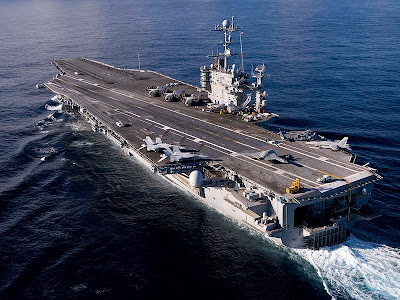
My twitter feed was abuzz today with statements lauding this morning's launch of the U.S. X-47B unmanned carrier air system from USS George H. W. Bush (CVN 77): "...another great first for naval aviation...History has just been made...Momento histórico...the Next Era of Naval Aviation...Launch Catapults Naval Aviation into the Future...New era in warfare...MOMENTOUS...Watershed...a pivotal milestone in naval aviation...game-changing technology," etc. There is a bit of truth in all of these.  Though perhaps the event is best summarized in the words of Vice President Biden.

Saving Money with Common Control Systems

Image
In a previous post , we cited funding threats to U.S. Navy unmanned systems programs and specifically called out ONR for some questionable R&D efforts.  In an effort towards fairness, the below video explains how ONR is working with other partners on a Common Control System for unmanned vehicles which will provide joint interoperability and produce a significant return on investment.  CCS is a hardware-agnostic tool using Kutta Tech's Bi-Directional Remote Video Transceiver to not only view sensor feeds from UAVs, but to control the sensors themselves and reduce operator workload.  

India Looks to Prevent Another Mumbai Attack With UAVs

Image
India's  growing unmanned aerial vehicle fleet is being put through its paces in defending against a future Mumbai-style complex terrorist attack.  During a 48-hour long exercise, Gemini-2 , UAVs from the Navy’s 342 Air Squadron cued patrol boats and coastal police to thwart mock terrorists attempting to infiltrate Southern India's shoreline from the sea.  The first iteration of Gemini was held in November 2012 and other multi-agency coastal security exercises ( 'Sagar Kavach' ) have been conducted frequently since the Lashkar-e-Taiba attacks on Mumbai in 2008. India's ground-based tactical Searcher MK II and longer-ranged Heron UAVs are a component of a more comprehensive maritime observation network consisting of manned aircraft, cooperating fishermen, and coastal surveillance radars and cameras installed in 90 light houses along India's 7,500 km coastline.  India's army and air force are ...

Estimating Cost Savings for UCLASS

Image
The past few years has seen a mostly uninformed tit for tat in the media and blogosphere regarding the costs of operating unmanned vehicles, especially when it comes to the personnel involved in operating and supporting them.  Those favoring drones often overlook the back-end costs of analyzing large amounts of data gathered by persistent intelligence, surveillance, and reconnaissance missions.  Those in support of manned aircraft discount the ability of single operators to control one or more autonomous aircraft, the fact that training and proficiency requirements are much lower for drone operators than manned aviators, and often mistakenly compare cost platform for platform rather than total time on station, or "orbits." As the U.S. Navy plans significant investments in programs such as the UCLASS aircraft, additional analysis will need to be undertaken in order to develop more accurate long term budgets for these systems.   Towards this end...