Posts

Fiscal Reality Hits the Navy's UAV Fleet

Image
Though budgets for unmanned systems in the U.S. Navy have been growing rapidly the past few years, even these programs have not been immune from the chopping block in the 2014 budget.  Several cuts have been announced in the past weeks.  The RQ-21 program appears to be shaved from both a Navy and Marine Corps system to possibly a Marine Corps-only aircraft to be deployed on and from Navy ships.  Some technical delays and likely budget shortfalls have caused delays in production of Northrop Grumman's exorbitantly-costly MQ-4C Triton UAV, with $25 million shifted from Fiscal Year 14 to 15.    Triton UAV production has been delayed.  Will other Navy drone programs feel the pain? The future total buy of another important ISR aircraft, Northrop's MQ-8 Fire Scout , is up in the air.  During a briefing on the FY 14 budget, Deputy Assistant Secretary of the Navy for Budget Rear Admiral Joseph Mulloy remar...

Dominating the Littorals with Unmanned Systems?

Image
In the current edition of Proceedings , Peter von Bleichert contends that a new form of dedicated drone mothership, combined with unmanned surface, underwater, and air systems, can dominate in future littoral combat.  A few observations: The author argues that "The littorals are too dangerous for the big expensive submarines and ships of the Navy and their crews, and they are far too dangerous for smaller manned vessels that lack comprehensive defensive and offensive systems."  There is truth the threat to surface ships in the littorals is greater than ever, with layer upon layer of anti-access threats available to state and non-state adversaries, including mines, fast attack craft swarms, and ground-launched anti-ship cruise missiles.  On the other hand, there are some missions that simply can't be performed by robotic systems, and likely will never will be.  Chief among these is the...

Evaluating China's Anti-Ship Drone Swarms

Image
The Project 2049 Institute recently released a report on People’s Republic of China UAV advances, with a focus on how those capabilities could be used to threaten U.S. Navy carrier strike groups.  China's expanding land and sea-based UAV inventory ranges from small tactical systems to medium-ranged Predator-class to UCAVs still under development.  This Anti-access/Area Denial capability, or A2/AD in naval parlance, represents just one of several layers of offensive systems the PLA is developing to exercise naval hegemony in the Western Pacific.    The report argues that "UAV systems may emerge as the critical enabler for PLA long range precision strike missions within a 3000 kilometer radius of Chinese shores."  This 3000 km radius represents an area well into the so-called Second Island Chain, control of which is commonly recognized as a long term strategic goal for the PLA. The report details Chinese strategists' plans t...

Private UAVs for Maritime Conservation Operations

Image
Navies and Coast Guards aren't the only organizations using unmanned air systems for maritime surveillance operations.  Drones in marine wildlife protection roles are a fast growing trend.  UAS offer several advantages to these operations.  First, they are much more affordable than manned aircraft, something that is important to non-profits on a budget.  The UAVs are also quieter than helicopters or aircraft, a critical advantage to not spooking the animals being protected and the poachers who are being monitored.  Finally, small UAS are easily and cheaply transportable to austere locations.  Here are several examples of this growing trend: In 2010, the Sea Shepherd Conservation Society used an Osprey UAS produced by Hangar 18 for the first time in their Southern Ocean whaling protection campaign.  This summer's fleet of four ships has deployed to Antarctica with three drones and the aircraft have already been suc...

This Month in History - RPV Targeting During Desert Storm

Image
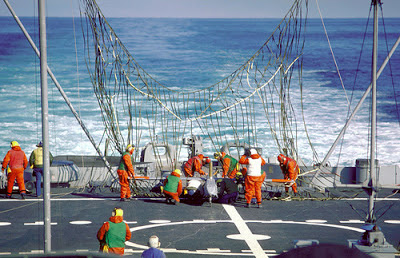
The U.S. military takes unmanned air vehicles for granted as they have been ubiquitous over the battlefield for the past decade.  But it wasn't too long ago they UAVs were an unproven novelty in combat.  The Naval History and Heritage Command  website has chronicled the myriad of ways that remotely piloted vehicles operating off U.S. battleships were used to support Navy and Marine Corps operations during Desert Storm this month 22 years ago. RQ-2 Pioneer UAV after recovery in the catch net device on the fantail of the battleship USS Iowa BB-62. (Official USN Photo) On 3 February, RQ-2A Pioneers from the USS MISSOURI (BB-63) were used for the first time to spot naval gun-fire when the ship "fired eight 1.25-ton shells from its 16-inch guns at prefabricated concrete command and control bunkers Iraq was moving into Kuwait, destroying the bunkers. The barrage, totalling 18,000 pounds of high explosives, marked the first combat firing of...

A Relay Race: Communication Relay Drones

Image
Much of the conversation surrounding the advent of naval drone warfare has focused on those platforms performing the more ‘kinetic’ types of warfare – anti-submarine warfare, surface warfare, air warfare – and those of the voyeuristic surveillance variety. However, a quick look at the composition of the carrier air wings of the U.S. Navy or the dispersed air units of a land campaign reminds us that supporting elements such as electronic warfare and command and control (C2) remain an integral part of modern combined operations. While it may not be as “sexy” as the ability to deliver a missile on target, the ability to maintain battlefield communications is arguably more important as it is an enabler of nearly all other actions.   In January, The Aviationist described the U.S. Air Force’s reiteration of the importance and utility of airborne assets providing communications by developing a new line-of-sight system: The U.S. Air Force is trying to turn the targeting pods ca...

Tactical Employment of Drone Motherships

Image
As  discussed in an earlier post , dynamics between unmanned naval systems and the platforms that carry them are changing rapidly to accomodate new technologies and tactics.  Arguably, various types of drone motherships have the potential to transform mine countermeasures more than any other warfare area and the evolution in mine-countermeasures tactics towards the mothership-unmanned underwater vehicle (UUV) partnership is already underway.  One of the first major demonstrations of this concept occurred last summer during 5th Fleet's International Mine Countermeasures Exercise ( IMCMEX ) when a number of UUVs were tested from large amphibious motherships including USS Ponce ((AFSB(I)-15). Essentially, the Navy is moving from dedicated MCM ships such as the Avenger class minesweeper, to a trio of platforms: a Generation I mothership, carrying Generation II platforms (a RHIB specially modified to carry UUVs; seen b...