Posts

This Month in History - RPV Targeting During Desert Storm
Image
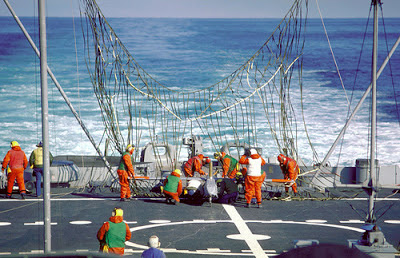
The U.S. military takes unmanned air vehicles for granted as they have been ubiquitous over the battlefield for the past decade.  But it wasn't too long ago they UAVs were an unproven novelty in combat.  The Naval History and Heritage Command  website has chronicled the myriad of ways that remotely piloted vehicles operating off U.S. battleships were used to support Navy and Marine Corps operations during Desert Storm this month 22 years ago. RQ-2 Pioneer UAV after recovery in the catch net device on the fantail of the battleship USS Iowa BB-62. (Official USN Photo) On 3 February, RQ-2A Pioneers from the USS MISSOURI (BB-63) were used for the first time to spot naval gun-fire when the ship "fired eight 1.25-ton shells from its 16-inch guns at prefabricated concrete command and control bunkers Iraq was moving into Kuwait, destroying the bunkers. The barrage, totalling 18,000 pounds of high explosives, marked the first combat firing of...

A Relay Race: Communication Relay Drones

Image
Much of the conversation surrounding the advent of naval drone warfare has focused on those platforms performing the more ‘kinetic’ types of warfare – anti-submarine warfare, surface warfare, air warfare – and those of the voyeuristic surveillance variety. However, a quick look at the composition of the carrier air wings of the U.S. Navy or the dispersed air units of a land campaign reminds us that supporting elements such as electronic warfare and command and control (C2) remain an integral part of modern combined operations. While it may not be as “sexy” as the ability to deliver a missile on target, the ability to maintain battlefield communications is arguably more important as it is an enabler of nearly all other actions.   In January, The Aviationist described the U.S. Air Force’s reiteration of the importance and utility of airborne assets providing communications by developing a new line-of-sight system: The U.S. Air Force is trying to turn the targeting pods ca...

Tactical Employment of Drone Motherships

Image
As  discussed in an earlier post , dynamics between unmanned naval systems and the platforms that carry them are changing rapidly to accomodate new technologies and tactics.  Arguably, various types of drone motherships have the potential to transform mine countermeasures more than any other warfare area and the evolution in mine-countermeasures tactics towards the mothership-unmanned underwater vehicle (UUV) partnership is already underway.  One of the first major demonstrations of this concept occurred last summer during 5th Fleet's International Mine Countermeasures Exercise ( IMCMEX ) when a number of UUVs were tested from large amphibious motherships including USS Ponce ((AFSB(I)-15). Essentially, the Navy is moving from dedicated MCM ships such as the Avenger class minesweeper, to a trio of platforms: a Generation I mothership, carrying Generation II platforms (a RHIB specially modified to carry UUVs; seen b...

LCS Program Office for Unmanned Systems in the News

San Diego's ABC affiliate recently did an informative piece featuring Captain Duane Ashton, from Naval Sea Systems Command Program Executive Office for Littoral and Mine Warfare Unmanned Maritime Systems Program Office (PMS 406).  Capt Ashton discusses some of the stand-off unmanned mine countermeasures capabilities under development for the Littoral Combat Ship (LCS) including the Unmanned Influence Sweep System (UISS)  and the Knifefish UUV. 

Dirty Jobs: Drone Edition

Image
Robots are frequently advertised as designed to perform jobs that are too dangerous, dirty, or boring for humans to accomplish.  Unmanned naval systems have also often been touted as a way to reduce the most expensive component of a Navy's budget - manpower - arguably a claim that has been hard to prove with some platforms.  However, an ongoing U.S. Navy robotics program might actually live up to both of these expectations.   Under a program initiated by the Office of Naval Research in 2009, SeaRobotics has delivered the latest variant of the  HullBUG (Hull Bio-inspired [formerly bio-memetic] Underwater Grooming)robot cleaner for  testing at ONR's Port Canaveral Large Scale Seawater Facility before the system moves into production.  HullBUG will autonomously remove the bio-fouling such as algae and barnacles that grow on ship's hulls.  Previous versions of HullBUG were tested on frigates at N...

Puma Goes to Sea (Again)

Image
U.S. 5TH FLEET AREA OF RESPONSIBILITY (Sept. 25, 2012) U.S. Navy Senior Chief Engineman Bradley Williamson, left, and Engineman 1st Class Michael Lamb assigned to Riverine Squadron Two, Detachment Three, conducts pre-flight checks on the Puma AE (Pointer Upgraded Mission Ability – All Environment) aircraft aboard Royal Fleet Auxiliary amphibious landing dock vessel RFA Cardigan Bay (L3009), as Royal Navy minehunter HMS Shoreham (M112) operates nearby. The U.S. Navy is currently testing Puma AE for land and shipboard operations in the U.S. 5th Fleet Area of Responsibility (AOR). U.S. 5th Fleet's mission is to conduct maritime security operations, defeat violent extremism and strengthen partner nations' maritime capabilities in order to promote security and stability in the U.S. Central Command AOR. (Royal Navy photo/Released) Continuing a recent string of articles on unmanned air vehicles, this month's US Naval Institute's Proceedings features an article (member...

Unmanned ISR and Future Air Wing Composition

Image
According to Defense News , the U.S. Navy's inventory of manned intelligence, surveillance, and reconaissance (ISR) platforms - land-based P-3 Orion and EP-3 Aries - will be cut by more than a quarter over the next few years.  The current consolidations are not the first time in recent history the Navy has trimmed ISR capability.  As late as  the 1990s, a typical carrier air wing deployed with a number of organic platforms capable of collecting intelligence, including tactical aircraft such as the F-14 with the Tactical Airborne Reconnaissance Pod System (TARPS) and ES-3A Shadows for electronic signals intercept (ELINT).  These aircraft were supplemented by a robust ground-based P-3 fleet along with numerous FLIR and radar capable helicopters on smaller cruisers and destroyers. Today's remaining manned aircraft, such as the venerable, but still effective, P-3s are today often found flying over-la...