Posts

Unmanned-Centric Force Structure
Image
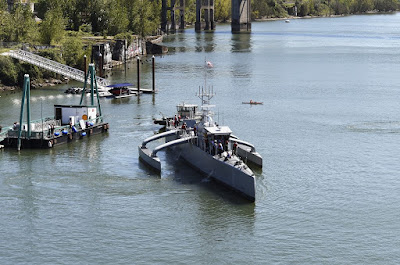
By Javier Gonzalez  The U.S. Navy is currently working on a new Fleet Structure Assessment, the results of which will eventually help inform the long-term force structure goals of the Navy’s 30-year shipbuilding plan. This ongoing analysis was generated due to the realization that some of the assumptions used to develop the current goal of 308 ships have changed significantly since its proposal in 2014. The Russian resurgence and China’s rapid military buildup defied expectations, and a review of the Navy’s force structure was absolutely warranted. The conundrum and implied assumption, with this or similar future force structure analyses, is that the Navy must have at least a vague understanding of an uncertain future. However, there is a better way to build a superior and more capable fleet—by continuing to build manned ships based on current and available capabilities while also fully embracing optionality (aka flexibility and adaptability) in unmanned systems. Additiona...
After Distributed Lethality - Unmanned Netted Lethality

Image
By Javier Gonzalez Distributed lethality was introduced to the fleet in January 2015 as a response to the development of very capable anti-access area-denial (A2/AD) weapons and sensors specifically designed to deny access to a contested area. The main goal is to complicate the environment for our adversaries by increasing surface-force lethality—particularly with our offensive weapons—and transform the concept of operations for surface action groups (SAGs), thus shifting the enemy’s focus from capital ships to every ship in the fleet. Rear Admiral Fanta said it best: “If it floats, it fights.” The real challenge is to accomplish this with no major funding increase, no increase in the number of ships, and no major technology introductions. The Navy has successfully implemented this concept by repurposing existing technology and actively pursuing long-range anti-ship weapons for every platform. An illustrative example of the results of these efforts is the current initiative to once...

Unmanned Systems: A New Era for the U.S. Navy?

Image
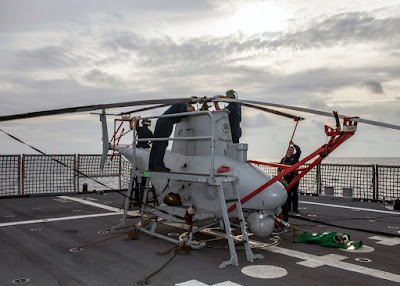
By Marjorie Greene The U.S. Navy’s Unmanned Systems Directorate, or N99, was formally stood up this past September with the focused mission of quickly assessing emerging technologies and applying them to unmanned platforms. The Director of Unmanned Warfare Systems is Rear Adm. Robert Girrier, who was recently  interviewed by Scout Warrior ,  and outlined a new, evolving Navy Drone Strategy. The idea is to capitalize upon the accelerating speed of computer processing and rapid improvements in the development of autonomy-increasing algorithms; this will allow unmanned systems to quickly operate with an improved level of autonomy, function together as part of an integrated network, and more quickly perform a wider range of functions without needing every individual task controlled by humans. “We aim to harness these technologies. In the next five years or so we are going to try to move from human operated systems to ones that are less dependent on people. Technology is goin...

The Future of Sea-Air Drones and Protecting Maritime Assets

Image
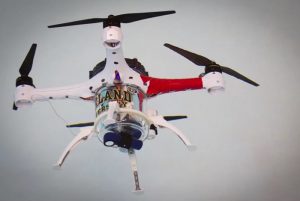
By Jack Whitacre What are some of the ways the U.S. and other countries could defend maritime assets against swarms of Sea-Air drones? Consider a convoy system with human centered technology, algorithms from nature, and elements of gaming. Oakland University’s Loon Copter works equally well above and below the water’s surface. Photo: Oakland University The FAA estimated that one million drones would be sold during this 2015  holiday season . This estimate was based primarily on the proliferation of flying drones, however new domains of operation may open up soon. Premiering in 2015, the  Loon Copter   proves that, in time, these devices will be capable of traditional aeri al flight, on-wa ter surface operations, and sub-aquatic diving. Embedded Systems Research at Oakland University created the Loon Copter in 2014. In 2016, the design placed third in the  UAE Drones for Good competition . The system works in air as well as in water because the four rotors bal...