Posts

After Distributed Lethality - Unmanned Netted Lethality
Image
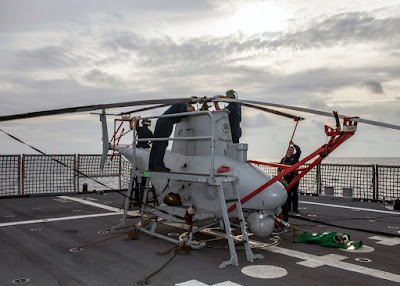
By Javier Gonzalez Distributed lethality was introduced to the fleet in January 2015 as a response to the development of very capable anti-access area-denial (A2/AD) weapons and sensors specifically designed to deny access to a contested area. The main goal is to complicate the environment for our adversaries by increasing surface-force lethality—particularly with our offensive weapons—and transform the concept of operations for surface action groups (SAGs), thus shifting the enemy’s focus from capital ships to every ship in the fleet. Rear Admiral Fanta said it best: “If it floats, it fights.” The real challenge is to accomplish this with no major funding increase, no increase in the number of ships, and no major technology introductions. The Navy has successfully implemented this concept by repurposing existing technology and actively pursuing long-range anti-ship weapons for every platform. An illustrative example of the results of these efforts is the current initiative to once...

Unmanned Systems: A New Era for the U.S. Navy?

Image
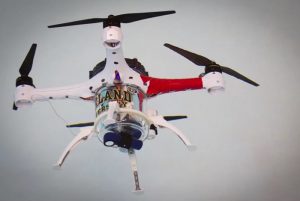
By Marjorie Greene The U.S. Navy’s Unmanned Systems Directorate, or N99, was formally stood up this past September with the focused mission of quickly assessing emerging technologies and applying them to unmanned platforms. The Director of Unmanned Warfare Systems is Rear Adm. Robert Girrier, who was recently  interviewed by Scout Warrior ,  and outlined a new, evolving Navy Drone Strategy. The idea is to capitalize upon the accelerating speed of computer processing and rapid improvements in the development of autonomy-increasing algorithms; this will allow unmanned systems to quickly operate with an improved level of autonomy, function together as part of an integrated network, and more quickly perform a wider range of functions without needing every individual task controlled by humans. “We aim to harness these technologies. In the next five years or so we are going to try to move from human operated systems to ones that are less dependent on people. Technology is goin...

The Future of Sea-Air Drones and Protecting Maritime Assets

Image
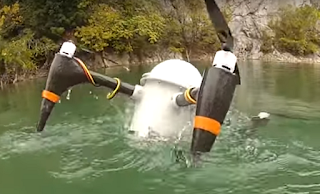
By Jack Whitacre What are some of the ways the U.S. and other countries could defend maritime assets against swarms of Sea-Air drones? Consider a convoy system with human centered technology, algorithms from nature, and elements of gaming. Oakland University’s Loon Copter works equally well above and below the water’s surface. Photo: Oakland University The FAA estimated that one million drones would be sold during this 2015  holiday season . This estimate was based primarily on the proliferation of flying drones, however new domains of operation may open up soon. Premiering in 2015, the  Loon Copter   proves that, in time, these devices will be capable of traditional aeri al flight, on-wa ter surface operations, and sub-aquatic diving. Embedded Systems Research at Oakland University created the Loon Copter in 2014. In 2016, the design placed third in the  UAE Drones for Good competition . The system works in air as well as in water because the four rotors bal...

Hybrid Drones - the Advantages of Operating in Multiple Domains

Image
Classifying unmanned maritime systems by their operating domain: air, surface, or underwater - is both convenient and intuitive. But recently, navy and industry researchers have begun to explore the advantages of platforms that can operate in two domains, muddying the nomenclature.  In the past year, several prototype multi-domain unmanned vehicles have been introduced.   CRACUNS The most popular combination of these hybrid drones is the air/sub-surface mixture - UAVs that float or swim.  Johns Hopkins University Applied Physics Laboratory in Laurel, Maryland introduced t he Corrosion Resistant Aerial Covert Unmanned Nautical System ( CRACUNS ), a submersible UAV designed to operate in the littorals which can be launched from a fixed position underwater or from an unmanned underwater vehicle (UUV). Rutger University's entry into the fray of flying/swimming drones is the Naviator , which can actually maneuver (sort of) underwater before surfacing and taking off....

Unmanned Systems & Strategic Futures at the Naval War College

Image
The Naval War College remains the center of the U.S. Navy's  foremost strategic thinkers.    Later this month, various experts from the military, academia, and policy communities will convene in Newport for a   maritime strategy symposium .      Some of the presenters will focus on the impact that unmanned vehicles have produced on naval strategy.    From the Naval Post-graduate School, retired Navy Captain Jeff Kline will discuss his paper on   Impacts of the Robotics Age on Naval Force Structure Planning ." Captain Kline’s paper emphasizes the importance of offensive “ payload over platforms ,” in order to overcome impediments to enhancing future force structure. In his words, “This package focus” first is particularly applicable in the electromagnetic and cyber realm. Inexpensive, deposable UAVs employing radar reflectors or chirp jamming may be better delivery platforms for EM “packages” than an F-18 Growler. In the offense...

Mitigating Cosite Interference in UAVs

Image
by Doug King dking(at)polezero.com Military radios must be able to operate in severe cosite interference environments (Figure 1.1 defines cosite interference). Cosite interference is a problem faced by many RF and microwave communications platforms; including Unmanned Systems. Military radios often operate in close proximity to additional radios, giving rise to cosite interference. The following article explains the issues associated with military radios operating in close proximity to additional interferers and how Tunable Filters are utilized in real-time applications. Finally, MPG-Pole/Zero’s recent advances in mitigating cosite interference are summarized. Issues associated with military radios operating in close proximity to additional interferers:  Multiple transmitters coupled to antennas in close proximity create a condition called reverse intermodulation, characterized by the coupling of energy from one transmitter into the antenna of another, creating a simultaneo...