Posts

2014: The Year in Naval Drones

Image
It's time for our annual wrap-up of the stories on unmanned naval systems that most resonated on this site, social media feeds, and the public writ large.  Here are the top naval drone stories of the year: The introduction of UAVs for maritime missions by non-state actors, specifically migrant rescue and anti-piracy , became reality. The Royal Navy established a UAV Squadron  to intitutionalize its ScanEagle operations . Despite continued operational testing with the X-47B prototype, politics and indecision created further delays with the U.S. Navy's  UCLASS RFP (still not released by the way). Unmanned systems were key in the Malaysian Airlines Flight #370 Search . The  MQ-8C Fire Scout made significant strides towards its first operational deployment. The U.S. Navy's  Swarming USV program , really a plug and play unmanned craft system, garnered significant interest. Interestingly, the story that seemed to p...

Chief of Naval Operations Continues Focus on Unmanned Systems

Image
2 May 2014 - Chief of Naval Operations (CNO) Adm. Jonathan Greenert tours Pennsylvania State University's Applied Research Laboratory facilities to see firsthand their innovative anti-torpedo torpedoes and unmanned undersea vehicles. (U.S. Navy photo by Chief Mass Communication Specialist Peter D. Lawlor/Released) Since he assumed office in 2011, the development of unmanned systems payloads has been a priority during the tenure of U.S. Chief of Naval Operations Admiral Jonathon Greenert.  His recent  Position Report  provides updates to several programs discussed in his original  Navigation Plan. Highlights related to unmanned systems include: Undersea Warfare "In the fall of 2014, our large displacement unmanned undersea vehicle ( LDUUV ) program reached its first acquisition gate, Milestone A, which initiated technology development." Unmanned Air Systems "We continued testing the  X-47B  Unmanned Carrier Aircraft System Demonstrator, and for t...

Minehunting Robots in the Middle East: IMCMEX 2014

Image
This year's United States FIFTH Fleet's International Mine Countermeasures Exercise is well underway in Middle East waters, running until 13 November.  This third iteration of the exercise will be the largest ever, with 6,500 sailors from 44 nations and 38 ships participating.  As with past exercises , unmanned undersea vehicle detachments from several countries will show off their latest hardware in a realistic operating environment.  A total of 19 UUVs will take part in the waters of the Arabian Gulf, the Arabian Sea, and the northern Red Sea.  On the U.S. side, a focus will be placed on overcoming unmanned mine-countermeasures challenges including the transfer of sensor data at sea, reducing unmanned mission duration, and enhancing trust in autonomy.   One of the new unmanned technologies to be demonstrated during the exercise is Northrop Grumman's Mine-Hunting Unit (MHU) .  The MHU unmanned surface vehicle tested  its ability to deploy, tow, and...

Private Security Drones for Anti-piracy Ops

Image
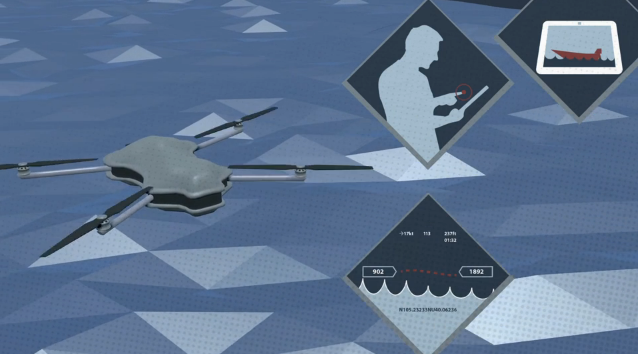
Depiction of ATAC Anti-piracy UAV. We've talked about privately-funded drones for maritime eco-activism  and   humanitarian operations , so it's not surprising to see another naval mission where unmanned air vehicles have bled into the private sector.  Now, at least one private security company has offered UAV services as an anti-piracy solution. Commercial shipping companies embraced private security as a means for protecting their ships after piracy in the Indian Ocean expanded significantly in the late 2000's, putting crews at risk and costing shippers billions in dollars in increased insurance premiums. Incidents of Somali piracy have been virtually non-existent since 2012, primarily due to the hardening of commercial shipping targets by embarked security teams. Other counter-measures, such as fire hoses, razor wire, and hardened crew citadels were too easily defeated by pirates, but to date, no ship with an armed security team has been successfully hij...

Groping in the Dark - Unmanned Underwater Navigation

Image
One of the more pressing technical challenges with today's unmanned underwater vehicles is maintaining an accurate navigational position.  Because GPS signals will not penetrate the water's surface, UUVs typically rely on inertial navigation systems and periodic trips to the surface to gain an accurate satellite fix. Aquanauts with REMUS AUV - NPS Photograph Bathymetric navigation, or finding one's ways through the contours of the sea floor, has been a tool used by mariners - both surface and subsurface - since the advent of sonar.  But accuracy was hampered due to inaccurate underwater charts and the processing limitations. Advances in sensors and computing may change these dynamics as explored in Ensign Jacob T. Juriga's recent  Naval Postgraduate School Thesis . Juriga's research focused on terrain aided navigation (TAN) through a series of autonomous vehicle trials near the Aquarius Underwater Research Station located in Islamorada, Florida.  There,...

The Navy's Swarming Robot Boats: Sorting Through the Hype

Image
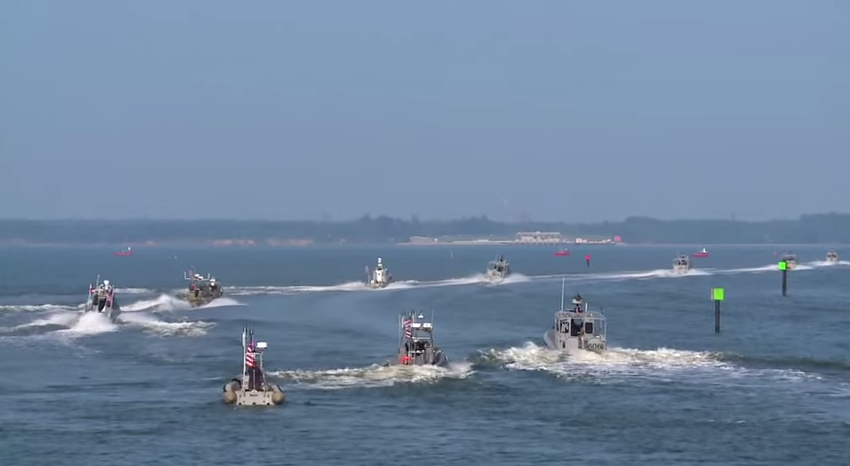
By now, most readers are familiar with the U.S. Navy's new swarming drone experiment using the  CARACaS (Control Architecture for Robotic Agent Command and Sensing)   system for automating small surface craft. The hype surrounding this development is significant, and some of it is rightfully deserved. Automated boats will find a place in future naval operations, but their capabilities and limitations must be more fully understood before that happens.  August 2014 - A swarm of CARACaS equipped patrol boats on the James River - U.S. Navy image. Capabilities The primary b enefits of autonomous unmanned vessels are longer endurance than manned patrol boats, and of course, a reduction in risk to human sailors.  Naval budgeteers consistently lament the cost of personnel, so o stensibly, automated boats will be less expensive than training and maintaining human crews.  On the other hand, the Navy's force protection boat crews, most of them resident in the...

On Defending Ships With Counter-Measure Drones

Image
Lieutenant Matt Hipple, United States Navy has begun a full court press to use unmanned systems as a form of defense against anti-ship missiles.   Here in Proceedings , he discusses the concept of unmanned aerial vehicles as a decoy to draw fire away from naval vessels. Matt sees these systems as a viable alternatives for shipboard defense to those currently in use, to include missiles, close-in-weapon gun systems, active electronic jamming, and passive distraction measures such as chaff. Here, he presents his case to  Athena East , When considering the ever-increasing numbers of sea and shore-based anti-ship missiles versus a smaller inventory of expensive defensive Standard missiles, the concept sounds reasonable.  The idea of aircraft as defensive ship decoys certainly isn't new.  In the Falklands conflict, Prince Andrew flew his helicopter in this manner to defend against Argentina's Exocet missiles.  "The helicopter is supposed to hover near the re...