Posts

The Most Realistic Fish-bot You've Ever Seen - and What it Could Mean for Naval Warfare

Image
Bio-inspired maritime robotics is an emerging field gaining significant traction. Two examples the U.S. Navy has funded include  Boston Engineering's Bioswimmer,  and the odd robotic jellyfish,  Cyro .  Both of these projects look clumsy compared to a robotic fish recently developed by a consortium of Polish researchers from the Technical University of Krakow, the marine technology firm  FORKOS, and the Polish Naval Academy.  The group's CyberRyba ("Cyber-fish") autonomous underwater vehicle can move along a preset route, but will eventually be able to autonomously  avoid obstacles and log data from a  sonar or video camera. The carp-like CyberRyba's uncanny realistic movement is aided by an articulating body and tail as well as independently moving pectoral fins allowing it to hover in place. The ultimate goal of the research is to support the European Defence Agency's "Swarm of Biomimetic Underwater Vehicles for Underwater ISR" (SABUVIS) pr...
OPVs and Drones: An Affordable Match

Image
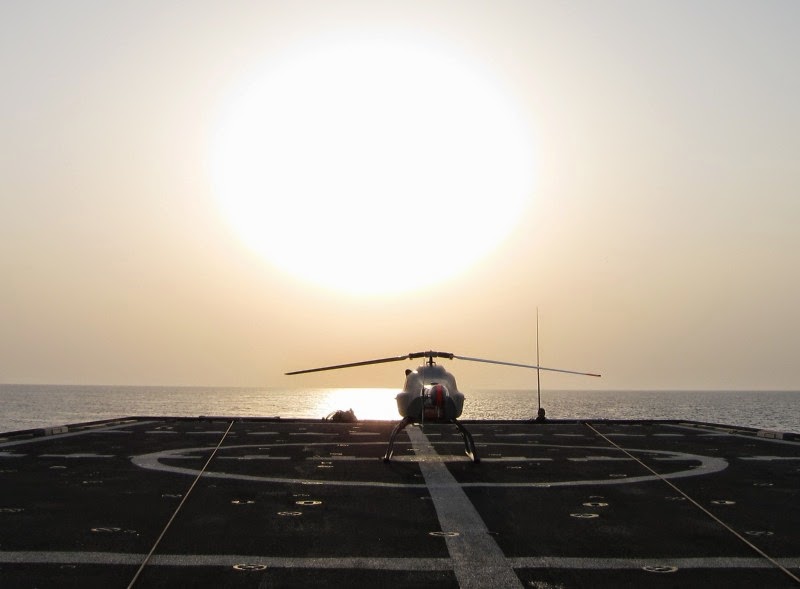
Unmanned systems are finding use on a larger variety of naval vessels, including those normally too small to operate helicopters.  Navies and coast guards operating Offshore Patrol Vessels (OPVs) in particular, are finding that unmanned systems can greatly extend the reach and versatility of these compact combatants. OPVs as a category are not well-defined; they're generally smaller than a corvette, larger than a patrol boat, and feature efficient diesel engines for long endurance,though generally at slower speeds than larger combatants.  They sometimes feature small flight decks (but usually not hangars), small-to-medium caliber naval guns, and a few have short-range surface-to-air missiles for self defense.  Though often conceptualized for coastal defense, the endurance and sea-keeping ability of OPVs often allows them to support global, open ocean missions. Skeldar operating on a Spanish OPV. The list of Navy OPVs operating as drone motherships is growing rapidl...

Drones and the Human-War Relationship

Image
Robots fascinate humans. They abound in movies: Star Wars, the Terminator, the Matrix. They are a foil for the human condition. In rosy predictions they are like Star Trek’s Data, “perfect” in strength and intellect yet void of emotion. In dystopian futures, killer robots are poetic justice. Created by humanity, robots attempt to annihilate their creators. If told killer robots exist in the U.S. arsenal, most Americans would probably think of “drones.” The name sounds robotic; it implies automaton behavior. Drones lack an onboard crew, and just like robots, drones fascinate Americans. In one important way, however, drones are not robots: they are flown by humans; they are just flown by remote control, but this creates a problem all of its own. The Armed Forces are not even sure how to deal with drone pilots. The pilots play a pivotal role in combat operations. They make life or death decisions. They press the button to fire missiles. They probably engage in more “lethal actions” th...

The Ever-Expanding Mission Set of Naval Drones

Image
Migrants rescued by the frigate Maestrale. Image courtesy Marina Militare. Hardly a single naval mission area remains that has been untouched by unmanned systems of the air, surface, or undersea variety.  Most recently, Italy's navy announced that with the help of surveillance from an unmanned air system, 1,049 African migrants en route to Sicily had been rescued.   The ongoing rescue missions are part of Operation "Mare Nostrum"(Our Sea), which has been underway since last fall when over 400 migrants from Eritirea and Syria perished near Italy's coasts. Presumably, the drone the Italians referenced was the ScanEagle, which was initially evaluated for ship-board use in October 2010. Two systems each consisting of 5 fixed-wing aircraft were purchased to be employed by the Maestrale Class Frigate beginning this year.  The Italians also recently acquired the  S-100 Camcopter , intended for counter-piracy duties in the Indian Ocean. 

A New Kind of Drone War: UCAV vs. UCLASS

The Australian government recently approved the acquisition of a fleet of US Navy  Triton   surveillance drones  to patrol our oceans. Australia has mostly used Israeli drones to date, such as the  Heron s in Afghanistan. So as we dip our toes into the American UAV market, it’s worth taking note of a recent development that might be threatening US primacy in this area. While the  Predator  and  Reaper  laid the groundwork for the use of armed drones in warfare, a question remains about the survivability of the technology against modern air defences. Developing a stealthy long-range drone with a decent weapons payload that could go beyond missions in Yemen and Pakistan appeared to be the next order of business for the US, especially in the future Asia-Pacific theatre. Projects like the demonstrator  X-47B  unmanned combat air vehicle (UCAV) have shown promise in achieving those missions. But for now the US Navy has decided to go for a...

How Naval Drones Could Help Solve the Mystery of Malaysian Airlines Flight #370

Image
If airborne search assets succeed in finding the wreckage of Malaysian Airlines Flight #370, what happens US Navy Towed Pinger Locator. next?  Generally, the key to determining the cause of air plane crashes at sea is dependent upon the recovery of the data recorder, or "black box" as it is generally known.  A black box has an acoustic "pinger" which is activated upon hitting the water and transmits a signal, sometimes for up to 30 days.  Once crash debris is spotted on the ocean, salvage experts will use predictive modeling software to determine an approximate location of where the aircraft actually went down.  Even small ocean currents of a knot or two can push floating debris hundreds of miles away from the original crash site over a two week period. At that point, if it is determined that one or more of the regional navies involved will search for the black box, a towed pinger locator will be deployed from a ship, a...

Unmanned Systems and Distributed Operations: Out of One, Many

Let’s face facts: it appears the U.S. Navy is incapable of building surface combatants, even small ones, for less than about a billion dollars apiece.  Consequently, it is likely the fleet will continue to shrink for the foreseeable future.  Yet it appears that the global demand for surface ship presence remains high for both peacetime operations and as an on-call force for contingency response.  So how can the Navy continue to meet worldwide operational commitments given fewer ships?  The key to maximizing the effectiveness of a declining surface force lies in combining suitable motherships with the latest unmanned warfighting technology.   Unmanned naval systems are rapidly proliferating internationally because they are increasingly capable and cheaper than manned alternatives for certain missions.  To date, sea-based unmanned systems have primarily conducted intelligence, surveillance, reconnaissance and mine countermeasures operations.  But w...